"If Careful Nursing Will Cure Them They Shall Have It"

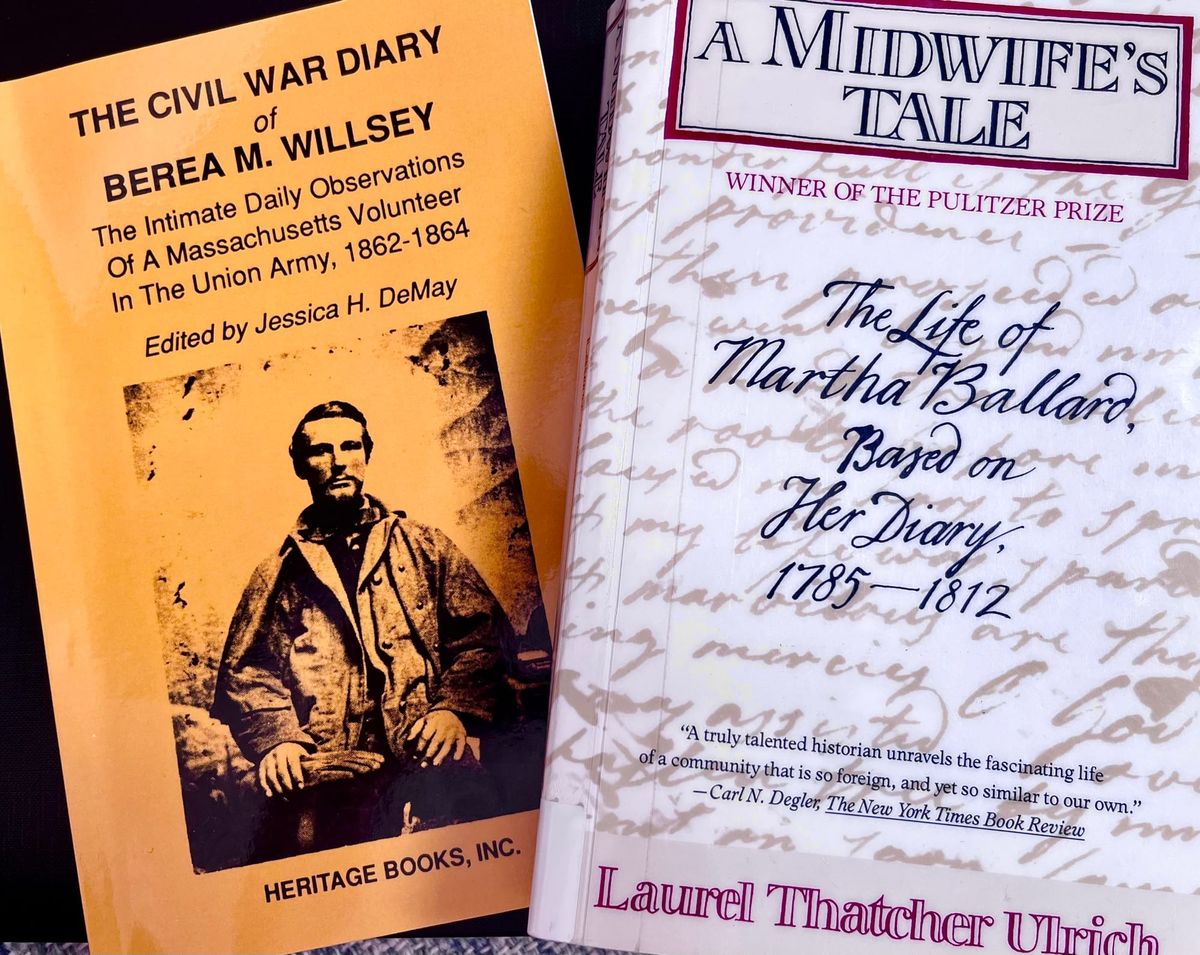
"That Martha Ballard kept her diary is one small miracle; that her descendants saved it is another." Laurel Thatcher Ulrich
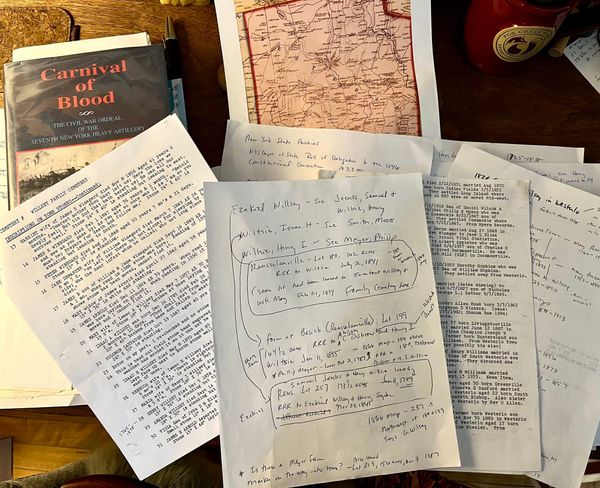
"The fact that these tattered and fading notebooks have survived is overwhelming. Berea carried the 1862 diary as he boarded the steamer Seashore and started the trip down the Potomac River and Chesapeake Bay . . . He marched through the mud and swamps, fought and nursed the sick all through the Peninsular Campaign. He wrote during the Battle of Fair Oaks, crossing and recrossing the Chickahominy River. He survived the Battle of Malvern Hill, carrying the hospital knapsack weighing 69 pounds." Jessica H. DeMay
This week I've been snooping into other people's diaries. Their writers were nurses in vastly different settings. Their personal testimonies are full of insights into settler life during a formative period in history. Thankfully, they've been preserved.
Martha Ballard (1735-1812) kept her journal from 1785 until her death, while she served as a midwife in a small settlement in Maine. Martha bore 9 children of her own and attended 814 deliveries, some of which were multiple births. A skilled practitioner, she was called in by her community to help with all kinds of illnesses.
My great-great-grandmother Harriet Gray was also a midwife in a small Illinois town where she and William, her Irish immigrant husband, settled after the Civil War. I was eager to read Martha's diary, to learn more about women's experiences around childbearing. Especially given the numbers of children my great-grandmothers had. Harriet bore 9 children. Her great-grandmother, Maria Willsey seems to have had 14.
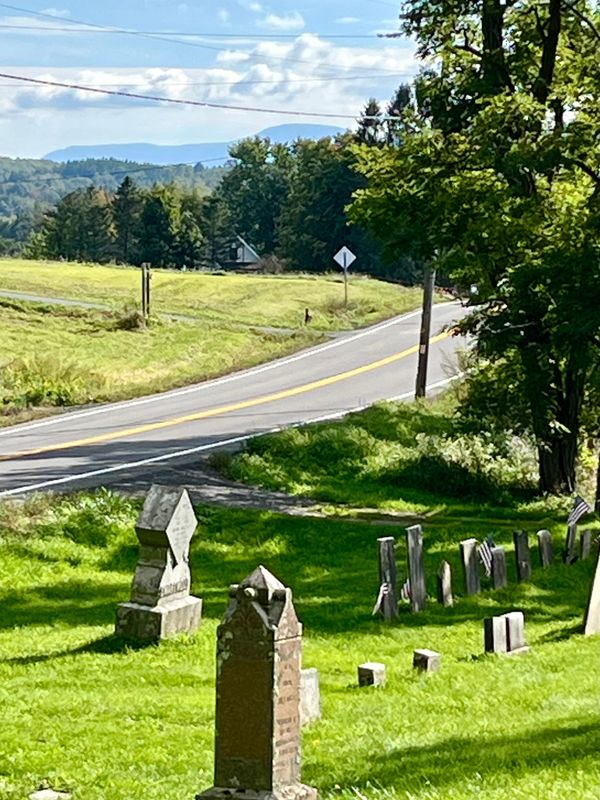
While tracking Maria's offspring, I found her grandson, Berea. At first I was primarily following interesting names: Berea's mother was the Sabra whose well-preserved tombstone I'd photographed on my trek to the farm cemetery. See that adventure here:
 Ruth Ann Smalley
Such were the lengthy childbearing spans of those days, that Maria had her first child in 1785 and gave birth to her last child, Berea's father George, in 1811. Her son Eliphalet, my direct ancestor who moved west like so many other land-hungry settlers by the 1830s, was born in 1794.
So, Berea was Eliphalet's nephew. But he was the same age as my great-great-grandfather, William Gray—who married Eliphalet's granddaughter. William and Berea were both born in 1839, the year the "Good Patroon" died and his will lit the fuse on the Anti-Rent Rebellion in upstate New York.
William and Berea both joined the Union army at 23. After their service, both men settled in the Midwest with their families. William died in 1917, Berea died in Nebraska the year after. Imagine my excitement upon discovering there was an intact Civil War diary penned by this cousin, and not only that, it was easily accessible. Another descendant had transcribed and published it in the 1990s.
Despite their toilsome and often dangerous lives, both Martha and Berea wrote virtually every day. In Martha's case, for 9,965 days. Her family lived in the unsettled post-revolutionary period, while Berea was in thick of another war.
Martha records fording icy rivers to reach laboring women, falling from her horse when it becomes mired in mud, and sitting bedside in patients' homes for hours and even days. Berea logs the ebb and flow of troop movements, their marches through streams and deep mud, his repetitive setting up and breaking down of hospital tents, and many strenuous night vigils.
Both are experienced in laying out the dead. Each is exposed to disease and the elements to a degree difficult for a modern reader to imagine. Even the acquisition of clothing and food is laborious.
As nurses, both alternate between action and attendance. Martha moves in response to messages from families, Berea waits for marching orders from above. While both have their hands full wherever they arrive, hours of waiting and watching are common.
Of the two, the woman seems to have more control over her circumstances than the man. She fills her time in between patients with productive domestic labor. She gardens and helps her daughters produce textiles and quilts. She's constantly visiting neighbors, both socially and for exchange of goods and services.
Martha also records the weather and her earnings, as she participates in countless transactions within a highly-interdependent community. She notes the comings and goings of her family as her daughters learn skills from other women, and her husband and sons run their sawmill.
In each chapter, Ulrich presents a selection of Martha's entries and discusses them, offering context and fuller explanations. This is especially helpful when it comes to social norms and legal issues, as when Martha describes marriages, out-of-wedlock births (such as one she attends where the young mother attests that Martha's own son is the father), and a 1789 case in which she is called to testify. This event is recorded in her diary with the sentence, "Mrs. Foster has sworn a Rape on a number of men"(102).
Ulrich also provides comparative statistics that show the success rates of midwives vs doctors at the time. Even compared with today's birth outcomes, Martha was a surprisingly capable midwife.
Berea seems more at the mercy of external forces and the chain of command. He's often seeking information, trying to sort out the rumors flying through camp. He awaits impending orders to move; sometimes those orders do come only to be countermanded. Berea spends hours, even days, not knowing what's going to happen next. Sometimes the troops have no rations and barely enough clothing. He himself once waits 3 weeks before he can put on a fresh shirt.
He waits for letters from home. He waits for it to stop raining. He waits for the paymaster to show up and the supply wagon to arrive. He waits for the dying men in his care to pass away. He is helpless to prevent even non-combat mortality: a soldier freezes to death in the night. Patients die of chronic diarrhea. After one battle, four men die overnight, simply from exhaustion.
Sometimes Berea managed to forage, such as the day they "stopped at 7 A.M. near a large corn field. Eat all the corn I could stuff down." Two days later, he "got two chickens, peck of potatoes & a lot of apples & pears. Had a tip top supper." Later that week, a mishap turns into a meal, as he's swimming, "when a monstrous great Crab caught me by the toe . . . I had some work to get the critter off. My toe bled pretty freely." He comes back with a fishing line "to catch a supper of Crabs. Succeeded beyond my expectation & I had a good meal." These glimmers of quiet humor are welcome amidst all the hardship.
Many entries simply say there is nothing to do in camp. In busy times, though, he's scrubbing down patients with mustard, tending wounds, or helping soldiers suffering from dysentery. He's chopping wood, tending fires, building a cookhouse, or simply trying to get some sleep.
I suspect that his diary, along with weekly letters to his father and his girlfriend, Lucy, are crucial to his mental health. They help him feel a modicum of control and consistency.
Berea's diary begins in March of his 3-year enlistment. By July, his 19-year-old brother Buell has been wounded at Malvern Hill and Berea can't find out what has happened to him. He waits for news, ultimately assuming Buell is dead. He is correct. Buell's body is never retrieved. By New Year's eve of 1862, he writes:
"I have nothing to do, so I shall go to bed as it is now dark & when I wake up I shall be all through with the Old Year. A year of hardships, of trials. A year of sorrow in the death of a Beloved Brother & hosts of Comrades that have fallen in Battle. Peace be to their ashes."
By February of 1863, he puts in for a furlough, and waits for it to be approved. He makes plans to visit his father, who had just moved to a farm in Hatfield, MA. He watches other soldiers take furloughs. His doesn't come.
Halfway through both diaries, I'm appreciating the glimpses they give of the period. It's odd to realize that Berea's diary provides more insight into his internal world than I've ever gotten from older relatives I actually knew.
Another thing that strikes me is that while textile production was becoming industrialized, people were still very engaged in the creation of their own clothing. Martha's 1788 diary entry illustrates how intertwined this was with life and death:
"Death of Doctor Colman's infant. I was there. Dolly finisht her web 44 1/2 yards. Beriah Ingerham had a son born. Clear. I went to Doct Colmans at 1 hour pm. His Child Expird at 4. I put on the grave Cloaths and tarried till 7. Colo North and Lady there. I found Mrs. Williams & Mrs Harris here at my return. I sett up till very late to finish Hannahs stockins" (72).
Spinning, weaving, knitting, and sewing everything from diapers to dresses all took place in the home. The Willsey women would still have been in charge of those activities in mid-century Westerlo, New York.
But with industrialization and land scarcity in New England, men were becoming more involved. George left Westerlo for Massachusetts, and just before the Civil War, the census shows them in the mill town of North Adams. George is listed as "cot. weaver," Buell as "carder," and Berea as "spinner."
By the 1865 census, George was a widowed farmer, living in Westerlo again. Berea had married Lucy and they'd moved in with George. By 1869, the young couple set out for a homestead in Nebraska. I'd thought George's grave was with Sabra's, but found him buried in Nebraska, where he'd later followed his son.
Before starting this project, I'd never heard of Martha Ballard or Berea Willsey. They now feel very real to me. Swept up into this large, complex tapestry of relationships, I can feel my sense of self and history transforming. When I read reports now on the conditions aboard the USS Abraham Lincoln, I can almost imagine what Berea might say, considering his view after the Battle of Fredericksburg in December of 1862:
"The men are all tired & hungry. . . .We have in this fight got licked like thunder & all because we have had no good General. When, Oh when will the Authorities at Washington learn something. 18,000 killed & wounded & not a single point gained. A fool could have done as well."