Beneath Our Feet: Hidden Histories

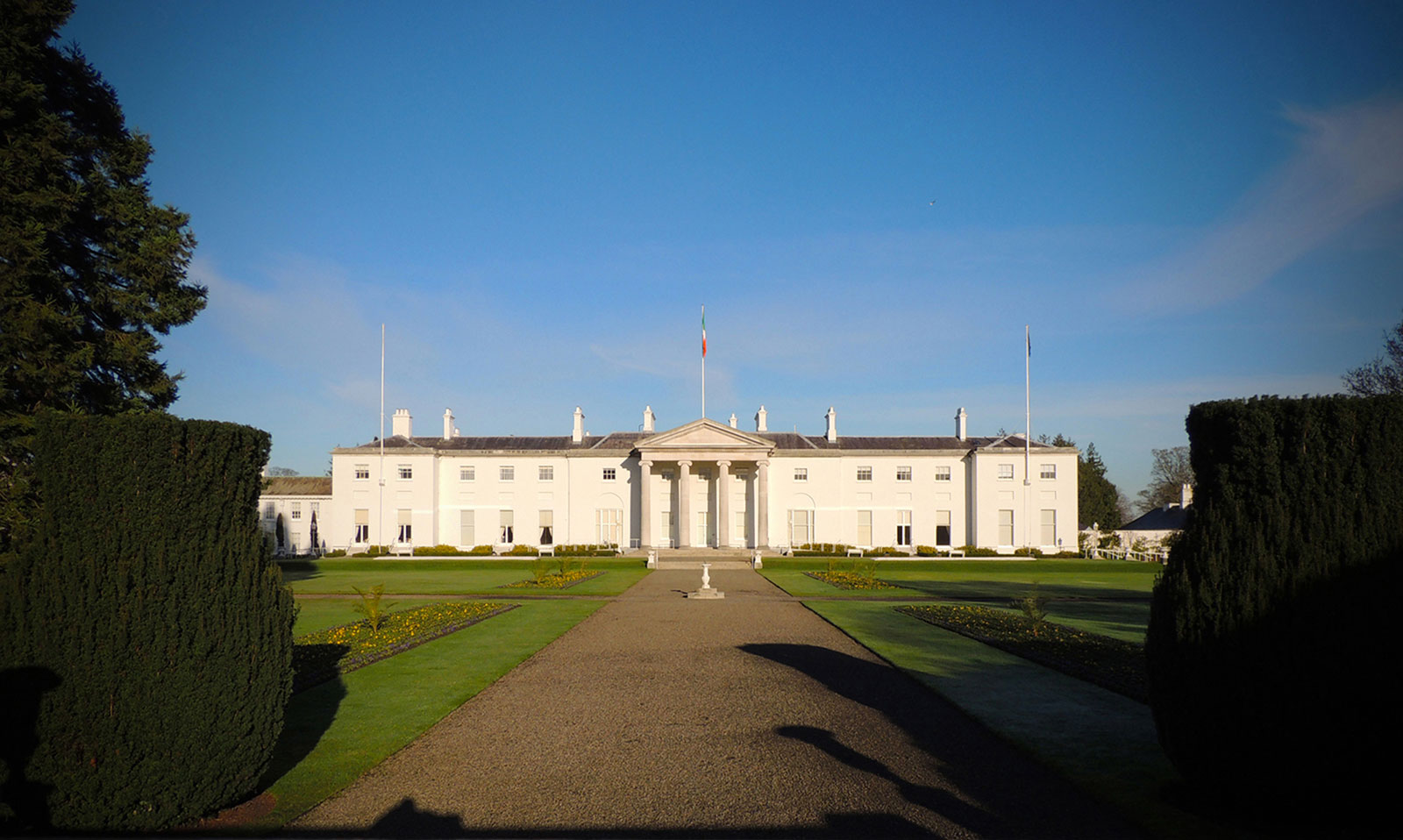
"I think it marks our maturity as a people that remembrance has become an act of self-awareness." Irish President Mary Robinson
Someone on social media recently lamented the fact that we haven't adequately memorialized or collectively grieved our pandemic losses. This made me think of Robinson's observation, made in the 1990s, about the disastrous events of 150 years earlier:
"It can take a long time for a people to recognise the impact on them of a particular event or defining moment."
Perhaps the greater the scale of the tragedy, the harder it is to face all of its meanings and repercussions. And the greater the urge to look away.

"June seemed to bring days full of purity and hope. Alas! These happy prospects would soon dim. Already terror began to reign." Annals of the Grey Nuns, 1847
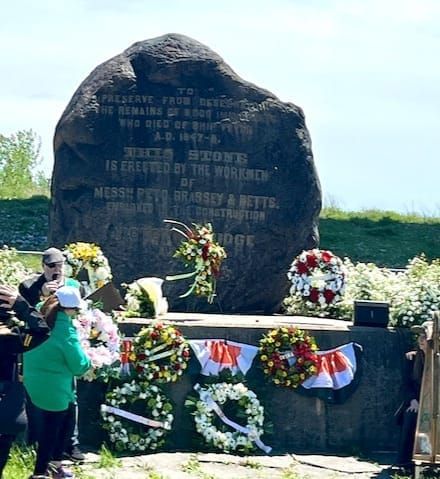
This past weekend I joined a group of people practicing remembrance. I went to Montreal, for the 158th March to the Stone. Also known as the the Black Rock, or Ship Fever Stone, the monument memorializes the 6,000 some Irish immigrants who fled famine 179 years ago, only to die there and be buried in a mass grave.
Robinson's idea of remembrance as an "act of self-awareness" resonates for me. Remembrance here being more than a reflex, but rather a deeply considered reflection coupled with action. Allowing oneself to sit with feelings of loss, pain, and injustice involves coming to terms with the world—reconciling the realities of human suffering and cruelty with the coexistence of compassion, love, and altruism. All of those realities were very much at work in the story of the immigrants' arrival in Montreal.
I've had difficulty grasping the many factors contributing to the Great Hunger itself, let alone the massive ripple effects of displacement and disease. On a personal level, it's been disorienting to realize how long I've been ignorant of this history—a recognition that also requires an act of self-awareness. I'm realizing that all my life I've shied away from finding out more, to avoid the feelings, the reflections. When I found out about the march, I felt drawn to attend. Spending time with the Grey Nuns' account of it also intensified my desire to participate.
In case you missed it, I've written more about famine cemeteries in Ireland and North America here:
 Ruth Ann Smalley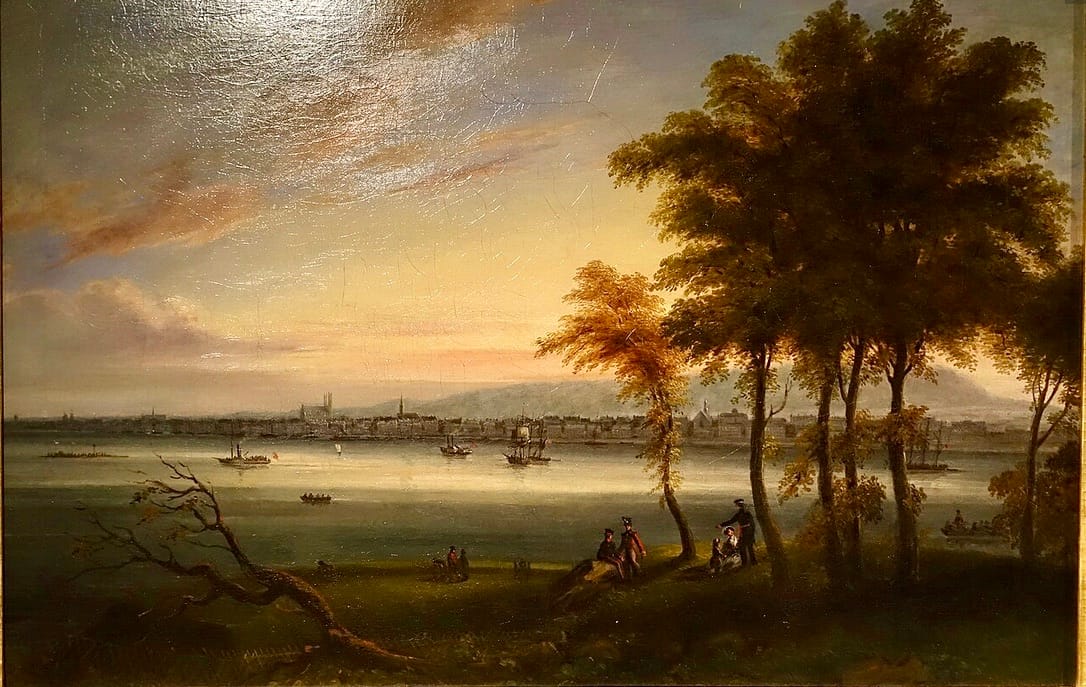
To briefly recap the events: about one hundred thousand sick and starving Irish immigrants reached Canada in 1847, fleeing extreme conditions at home. Many died on the 6-8 week journey in the filthy, crowded "coffin ships." Some died in quarantine at Grosse Isle. But many more arrived in Montreal, unknowingly carrying Typhus.
The introduction to Annals of the Grey Nuns describes how Montreal's coming "terror" unfolded:
"The number of emigrants arriving in Quebec on May 27th was 5,546, and on June 1st, 25 ships were expected to arrive"
The small city of 50,000 attempted to prepare. But the numbers and the severity of the disease exceeded the capacities of even the most well-intentioned. And of course, many residents were not happy to welcome them. The Grey Nuns, along with two other orders, Catholic and Protestant clergy, and others labored to care for the sick, often at the risk of their own health and lives.
The nuns describe months of heart-wrenching experiences in horrific conditions, struggling to offer care and consolation as the bodies accumulated:
"Towards mid-June, 6,000 Irish disembarked on our shores, 3,500 of which stopped at the sheds or ambulances. 2000 disappeared in search of more favourable pastures; many died.
There nevertheless still remains 250 in the shelters. On June 25th of this same year, the sick numbered 850 in the shelters; around twenty were dying each day. July 2nd, the sick numbered 1,300, the number of those who died went from thirty to forty a day.
Death did not only prey on the ambulances, it also victimized those in the city, as the contagion began to spread, and spiritual relief was becoming more and more urgent in several neighbourhoods."
(https://faminearchive.nuigalway.ie/docs/grey-nuns/TheTyphusof1847.pdf)
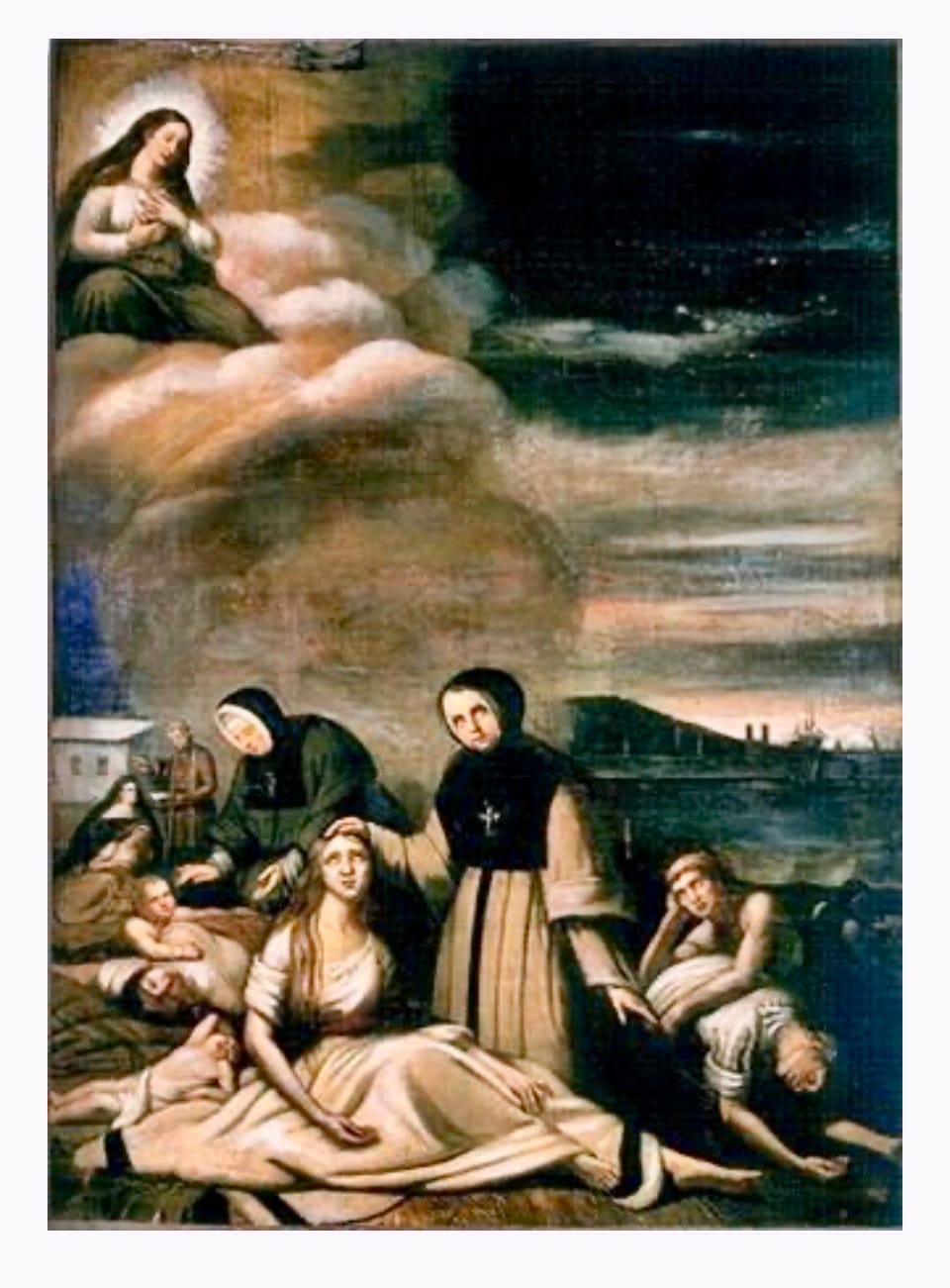
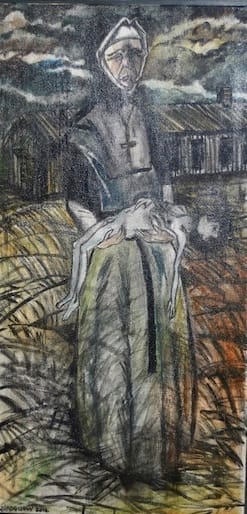
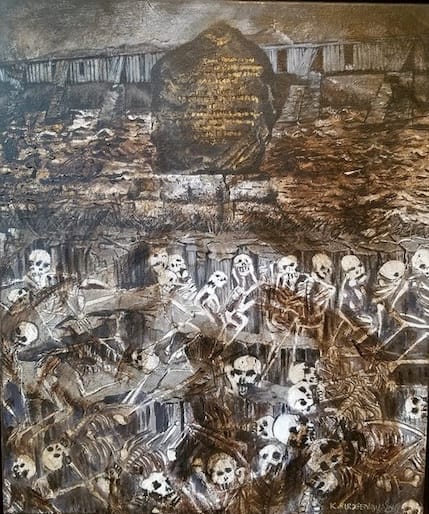
Theophile Hamel’s 1849 painting Le Typhus, at Montreal's Notre Dame-de-Bon-Secours, and Montreal artist Karen Birdgenaw's paintings for the 2019 Grey Nuns Exhibition
Many of those who helped the immigrants, including Montreal's mayor, died from Typhus that year. At the memorial, I learned that the large field nearby had been the site of the hastily erected fever sheds. But there had also been an earlier location, around which possibly another 1,500 to 2,000 of the deceased had been stacked in shallow trenches.
The math alone is stunning, apart from the implications for individual lives. These additional graves mean that in one year, along with thousands of surviving immigrants, Montreal absorbed a number of dead bodies equal to the entire population of my childhood hometown.
Those first unmarked cemeteries were disturbed by construction in 1876 (a whole story in itself), and are now threatened by plans for a large residential development. Historian Lisa Maguire offers a thought-provoking remembrance, here: https://ancestory.substack.com/p/history-montreal-cemeteries. The location of the Black Stone has had a long and contentious history, as the land has changed hands and Irish descendants have struggled to prevent desecration of the graves.
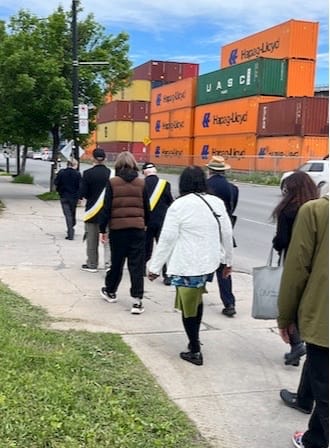
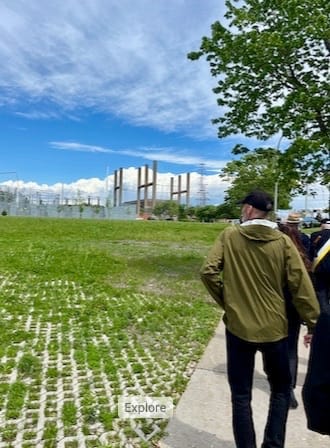
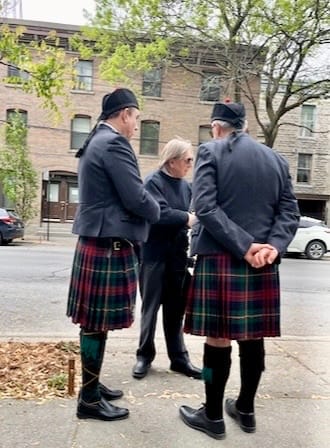
We met up outside a church after mass, and began following the bagpiper toward the industrialized port area. We passed by a Costco and lots of shipping containers. The current location of the monument is near a large power substation, in the middle of a heavily-trafficked street strip. On either side, cars fly by in both directions, while, as you can see in these photos, both ground level and elevated trains speed past nearby.
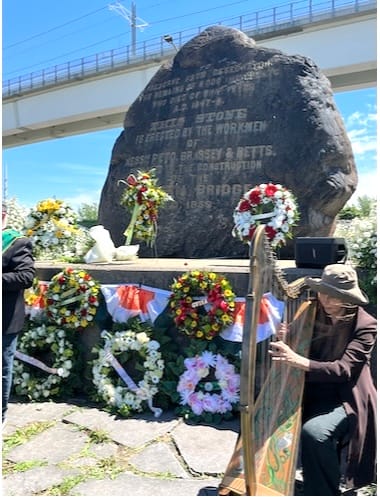
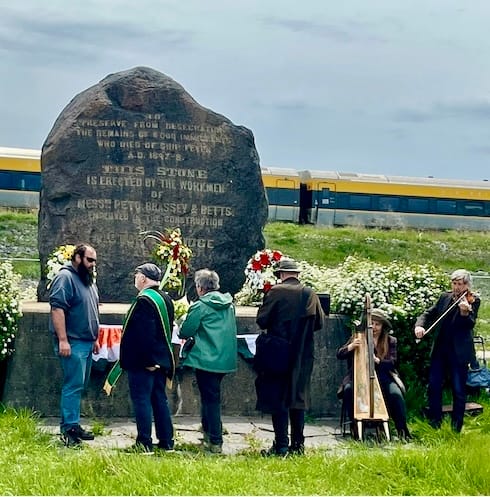
As the descendant of someone who left Ireland in 1845, in time to miss the worst of what was to come, it was sobering for me to imagine the feelings of those whose relatives lay beneath us. It was very strange to think about the 14 bodies of adults, teenagers, and children that were pulled from the earth here in 2019, when an elevated railway pylon was driven into the burial ground (see https://www.cbc.ca/news/canada/montreal/montreal-rem-irish-graveyard-analysis-1.6524416)
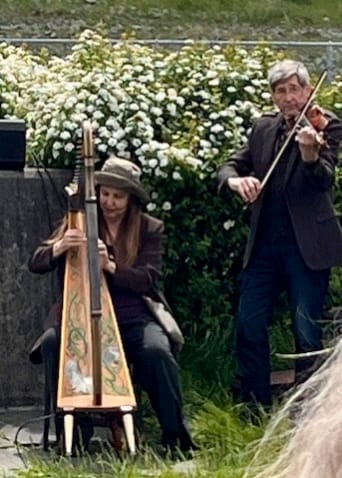
Participating in the memorial were out-of-town visitors like ourselves, as well as local people, musicians, and a historian who has long been involved in research into the burial grounds. The walk was led by members of Montreal's Ancient Order of Hibernians, along with a visiting representative of New York's AOH.
Many wish not only to preserve the graves from further desecration, but also to develop a park and interpretive center. One speaker expressed a desire to work with Mohawk artist, M.C. Snow, to bring a sculptural component to the site, similar to the collaboration along the Peel Trail. That installation was initiated by the discovery of a 14th century Mohawk settlement at a Montreal construction site.
It was designed in partnership between Snow and non-indigenous artist, Kyra Revenko. They created themed spheres, set in pairs to promote seated dialogue along a route traditionally traveled by the Kahnawà:ke community between the waters and the mountain. The art promotes a sense of ongoing learning and conversation between First Nations and "newcomers." You can find out more about this fascinating project here:
 Ville de Montréal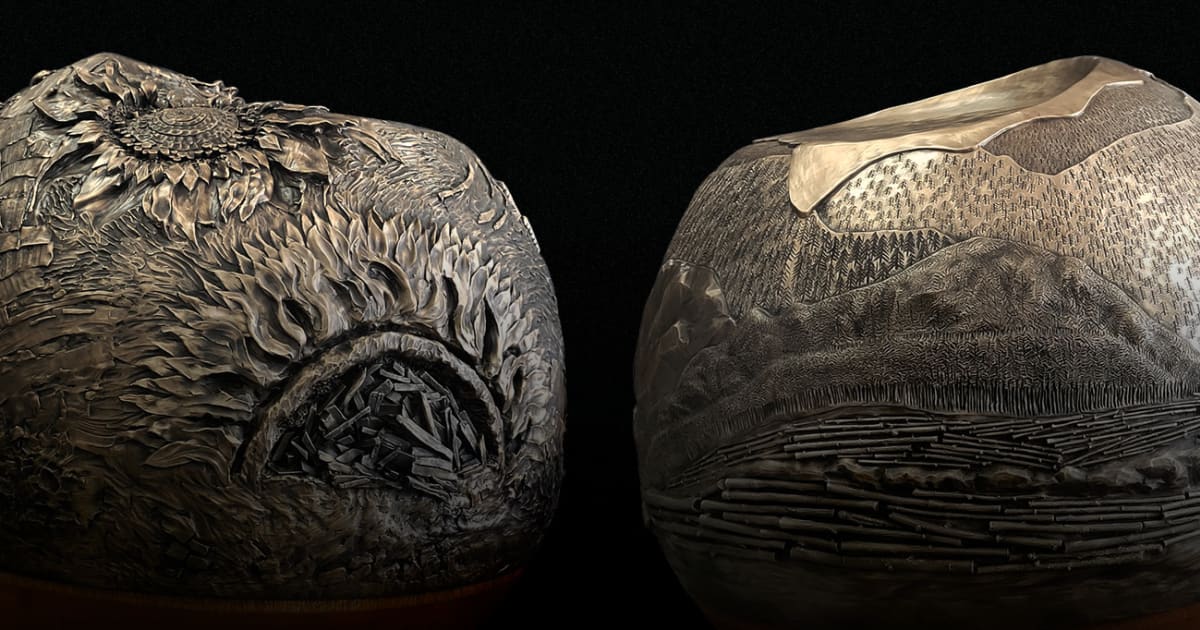
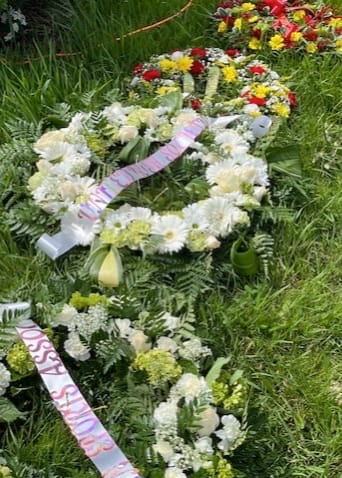
Acts of remembrance can help us be both self-aware and collectively-conscious, whether we enact them through stones, or spheres or wreathes.
To know about these histories is to begin to understand the complex relationships we hold to each other and the past. Learning about the helpers can inspire us to overcome the hurts as well as the societal impulses toward hurting others.
Unnecessary famines and preventable diseases still rage in our world today. The more we face and restore our historical knowledge, the better equipped we are to take action.
This poem by Desmond Egan was read as part of the observance at the Black Stone. It reverberates far beyond the 1840s. Famine, indeed, "is only a field away."
Famine, A sequence
the stink of famine
hangs in the bushes still
in the sad celtic hedges
you can catch it
down the line of our landscape
get its taste on every meal
listen
there is famine in our music
famine behind our faces
it is only a field away
has made us all immigrants
guilty for having survived
has separated us from language
cut us from our culture
built blocks around belief
left us on our own
ashamed to be seen
walking out beauty so
honoured by our ancestors
but fostered now to peasants
the drivers of motorway diggers
unearthing bones by accident
under the disappearing hills