Property, Survival, and Solidarity: A Prelude

History has been showing me its tantalizing side. Various ancestors' histories and journeys are linking together, and I'm sensing them spanning across time to this present place. By place, I mean not only where I live in upstate New York, but also the place we're in—our country's current political situation. This week's post acts as a prelude to a deeper exploration. I'm still working to limn our view of the connections and throughlines.
Currently, my head is spinning with discoveries, clues, and surprise over-lappings of different generations of immigrants and native people. Gathering information, I'm accumulating facts and, hopefully, a better understanding of them. This week, I'll briefly set the stage for some ocean-spanning conjunctions, to be revealed in the future.
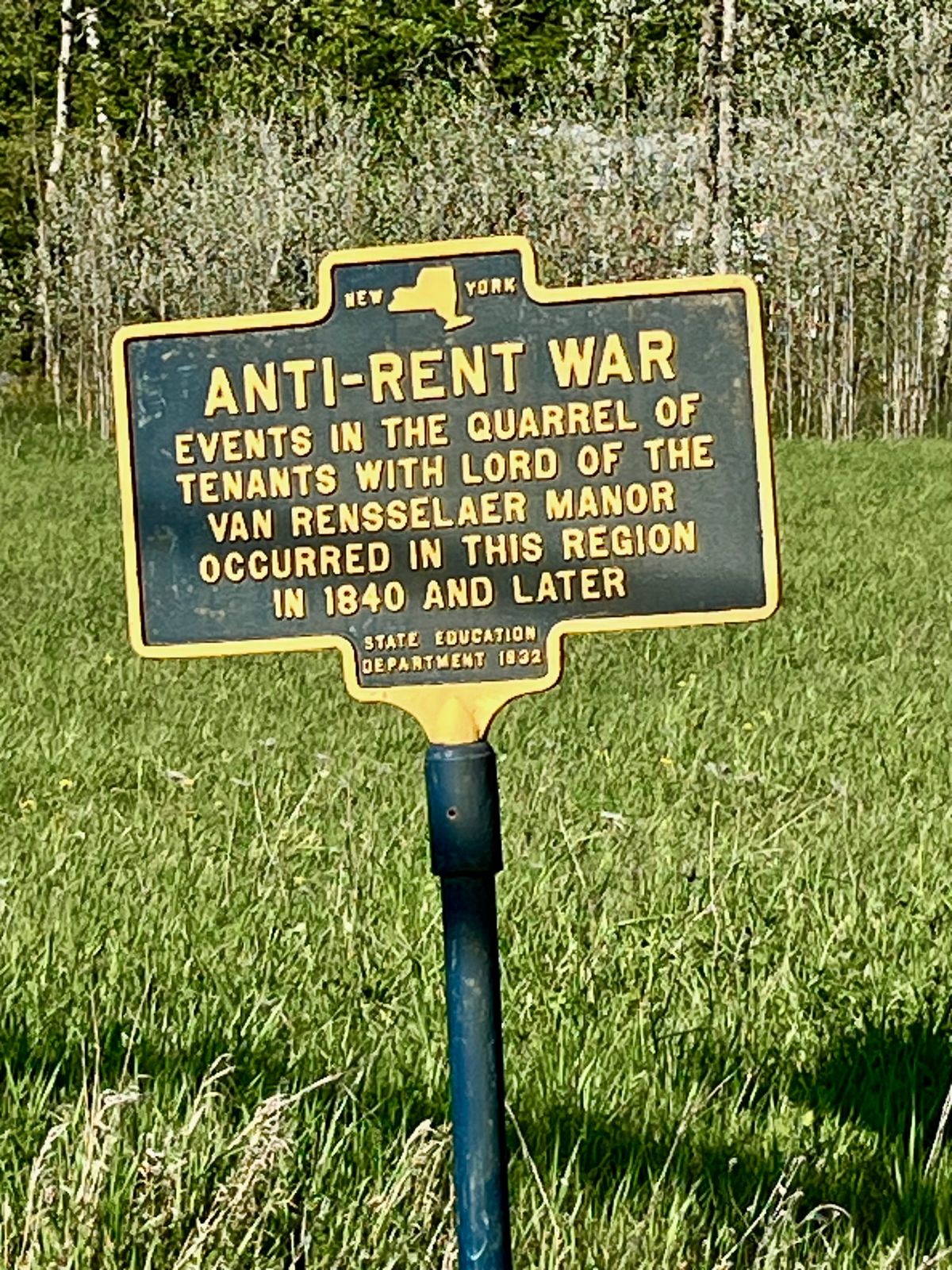
First, let's consider the bit of signage above, from New York's State Education Department, dated 1932. It is hard to imagine a less educational statement. It makes sense only if you are familiar with the history (I've heard that called the "coiak factor": clear only if already known). A quarrel of some sort. Then, events occurred, in the region, starting around 1840, and going on for . . . a while. There were tenants. There was a lord of the manor. In 1840? What?
I didn't grow up here, so I don't know how much New York residents learn about the Anti-Rent Wars as part of their education. I suspect that unless they live in one of the places where the "events occurred," they may have received only a broad-brushed version, say, around 4th or 5th grade. Not an age where we're likely to deeply understand or retain much about any period more remote than our own parents' lifetimes.
I first heard a reference to it about two decades ago, when a friend who grew up across the Hudson, in Troy, mentioned she'd been reading about the patroons. Patroon was an unknown word to me then. She had to explain that these were the mostly Dutch-descended owners of massive tracts of land, spanning both sides of the Hudson river. Millions of acres were under their control. They were, indeed, lords of manors.
Many of their names, like the Van Rensselaer noted on the historic marker, are plastered on street signs, sides of buildings, big institutions such as RPI (Rensselaer Polytechnic Institute), or whole towns around the region. Also, due to the Dutch system of mapping lands and town grids, we move physically through the continued influence of these wealthy families to this day.
But even after my friend's explanations, I didn't grasp a key fact: these basically feudal land arrangements from Dutch New York continued under the British, and later on, after the American Revolution.
On our travels to explore other towns in the region, we had occasionally driven through areas with such Anti-Rent War references. But in the years since my friend shared those tidbits about patroons, I hadn't acquired much more than a general understanding: tenant farmers, aggrieved with the conditions of their rental agreements, had rebelled in a series of "down-rent" uprisings. There was much more to the story than the minor spats or random kerfuffles that I might have imagined. It's a story with so much relevance to my ancestors and to modern issues.
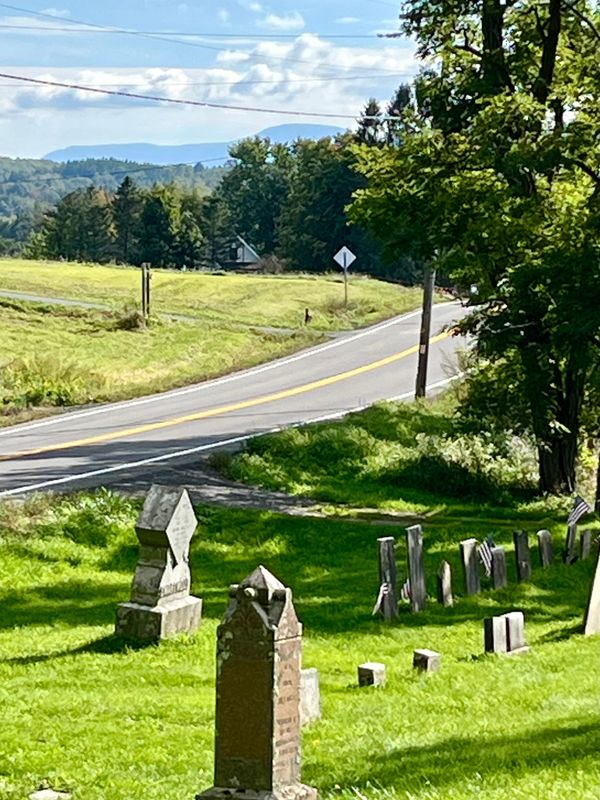
Pictured below is an area outside the city of Albany, near the Helderberg Escarpment. Referred to as the hilltowns of Berne, Knox, and Westerlo, the land fell within the Manor of Rensselaerwyck claimed by the hereditary Van Rensselaers. Here's how Henry Schoolcraft offered its history in verse in 1845:
"For Helderberg had groaned and shook for years/ E'en from the time that Holland hither sent/ Her yonkers, boors, and lordly patroons-peers/ To hoard up beaver-skins, and wheat, and rent . . ."
(From Helderbergia, qtd in Nancy Newman's 2025 book, Songs and Sounds of the Anti-Rent Movement of Upstate New York)
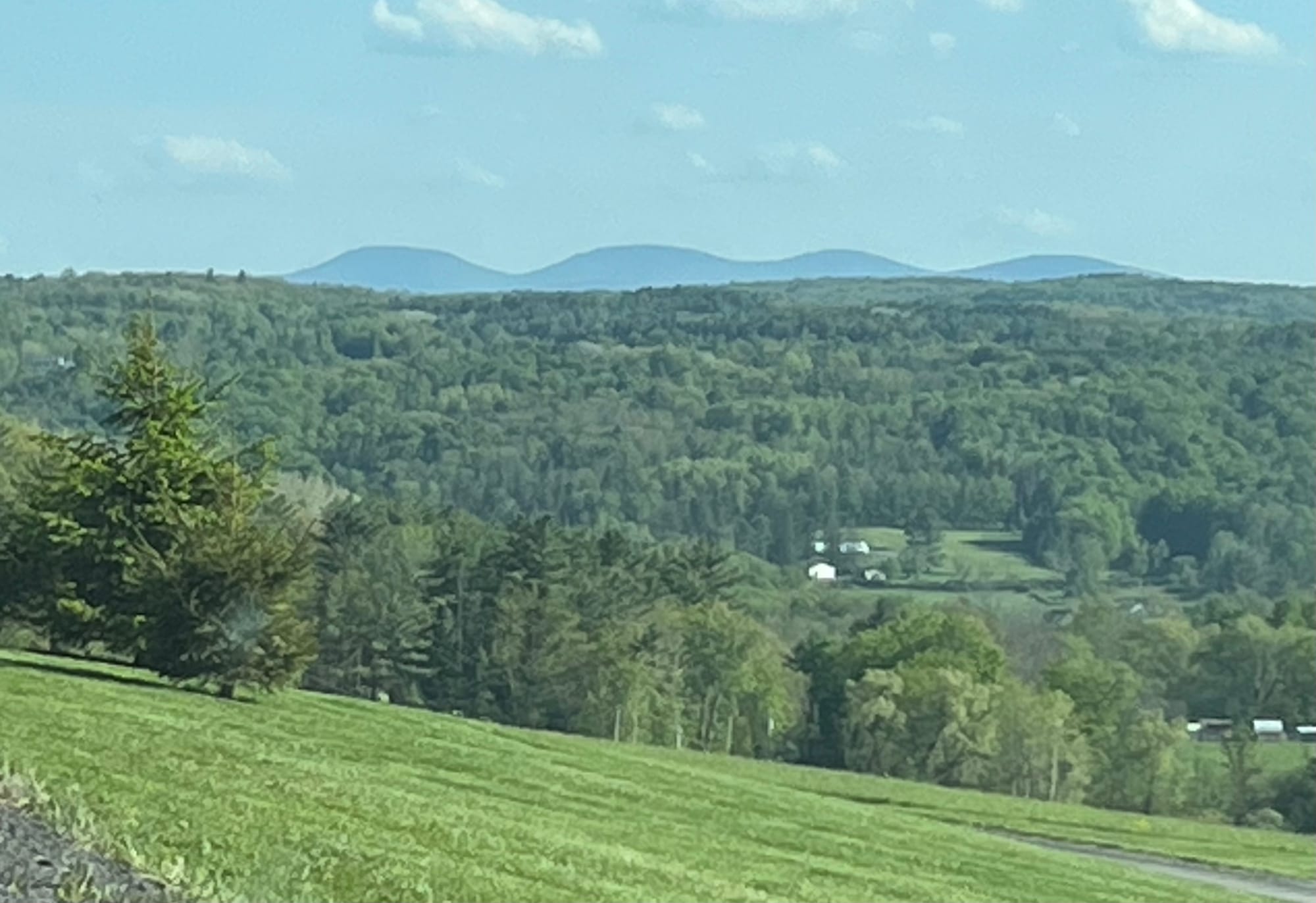
I hopped out of the car to take this picture from a roadside in Berne. From here you can see all the way to the Catskills, also populated by tenant farmers. According to Reeve Huston's book, Land and Freedom: Rural Society, Popular Protest, and Party Politics in Antebellum New York, the counties in the Catskills were "a crazy quilt of small and medium-sized tracts owned by different landlords, leased under a variety of terms, and interspersed with areas of freehold farming"(14).
In the future, I'll say more about Schoolcraft's reference to landlords hoarding up. I'll get into more details about how these terms—which typically prevented farmers from "owning" any improvements they'd made to the land—impacted successive generations of farm families.
Suffice it to say when landlords stepped up efforts in the 1840s to collect back rent, threatening to sue or evict farmers and seizing their livestock or goods to auction off, a bold resistance movement arose.
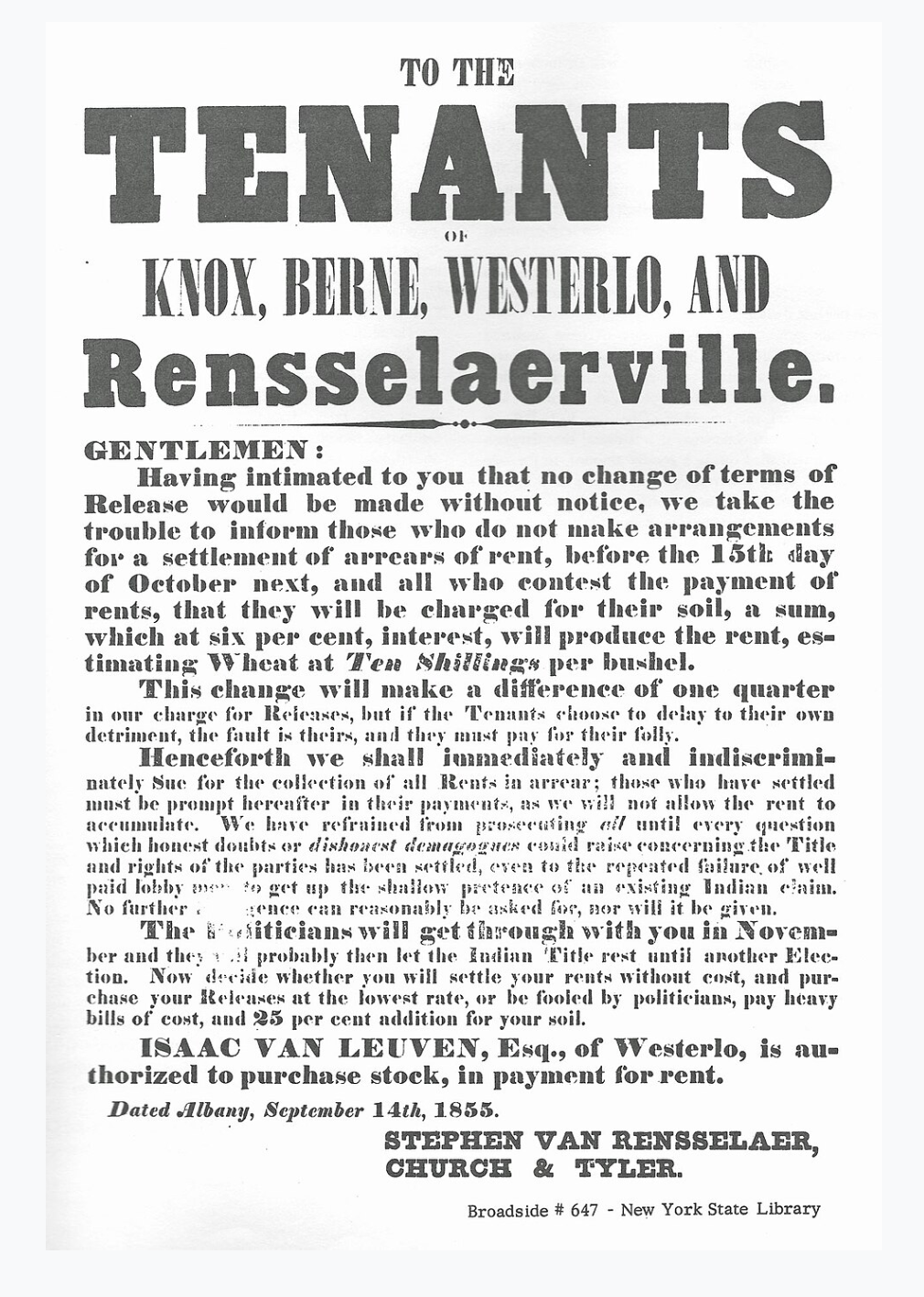
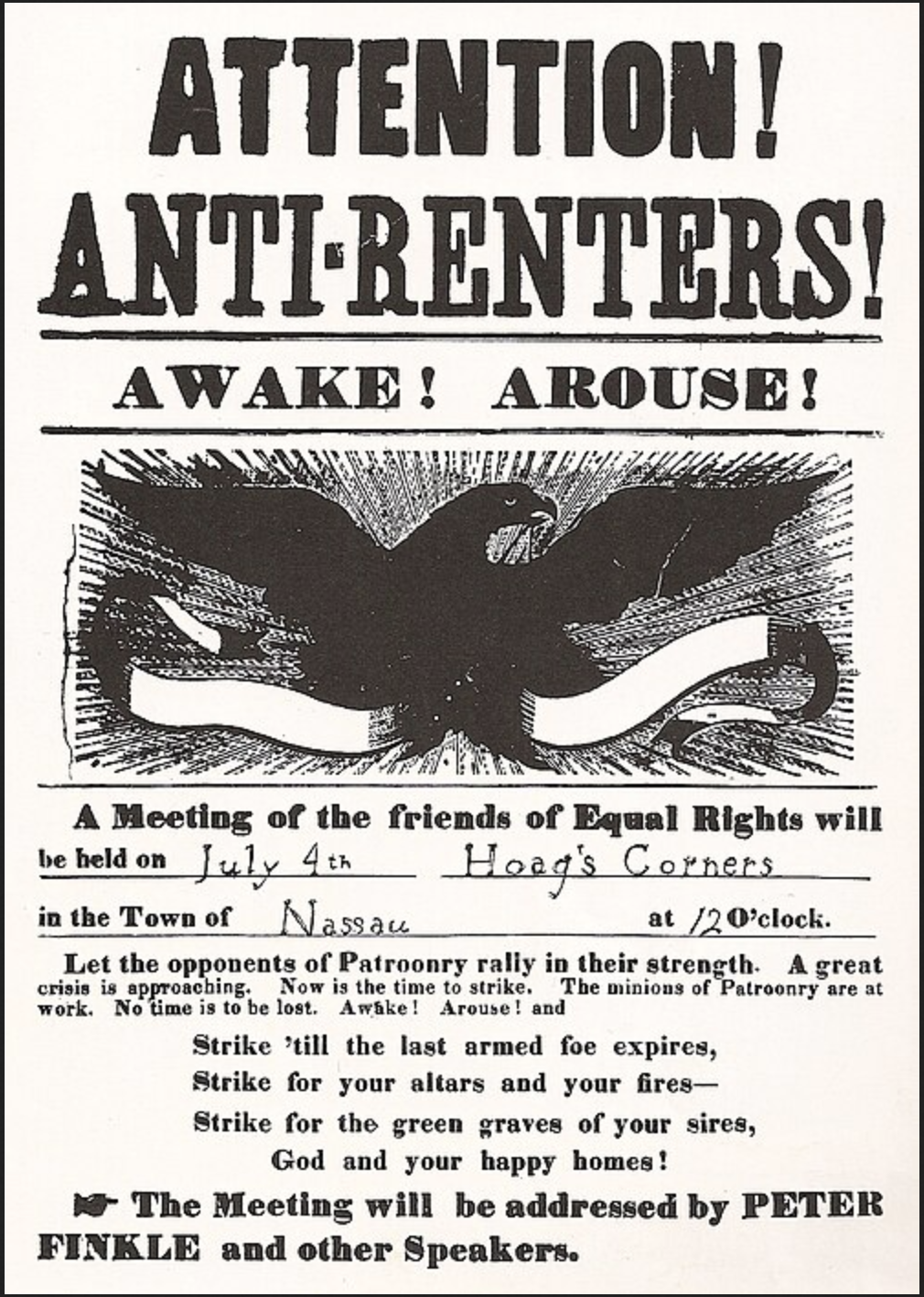
Announcements of measures and counter-measures. (Wikimedia)
It had a surprising uptake in farming villages across the region. Many of these farmers lived in small, rough cabins and were barely scraping by. In a show of solidarity, thousands of tenants got involved in public rallies and parades, and worked to organize political lobbying efforts. They donated their hard-come-by cash to the cause. They were joined by others, like town doctors and other non-farming interests, who supported their campaign.
Many also formed secret militias, to pressure reluctant farmers to support the rent strike, and to intimidate the landlord agents who came to serve eviction papers. Sometimes they tarred and feathered them.
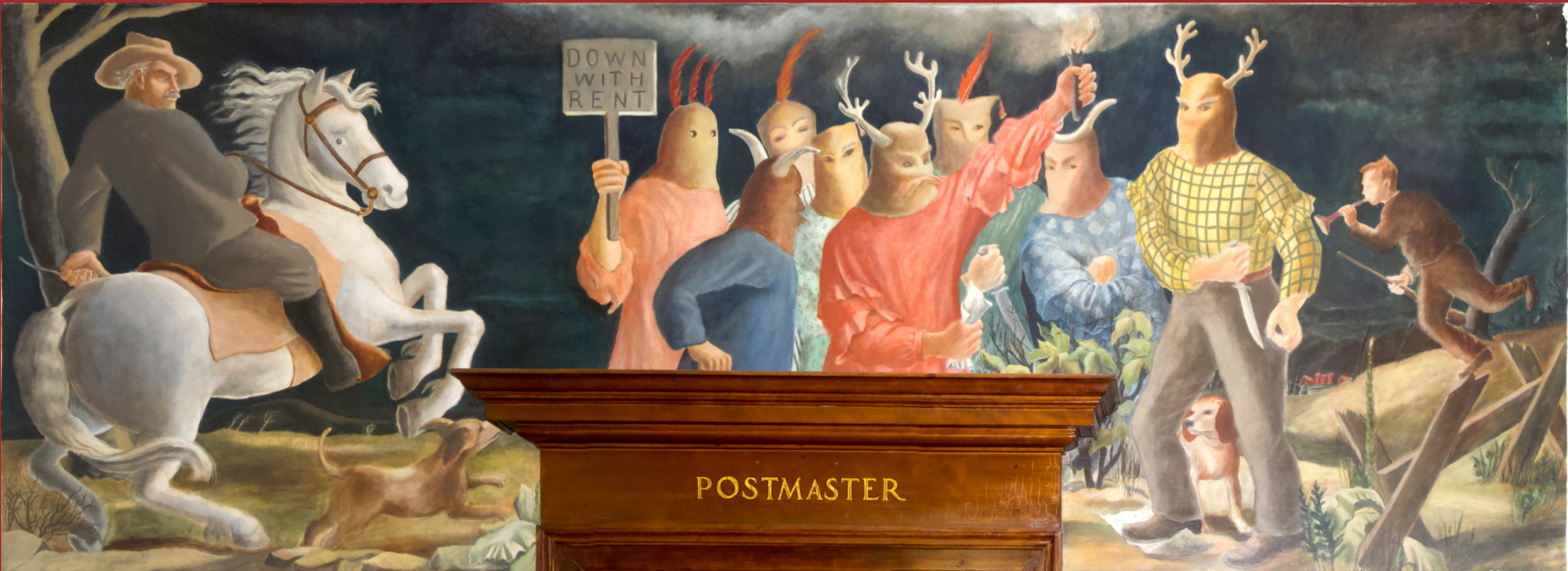
For anonymity, militia members wore leather masks and loose tunics. They were heavily armed, some with guns and axes; many brandished sharp farm implements. Taking a cue from the Boston Tea Party, they called themselves the "Calico Indians." These men meant business.
WPA artist Mary Earley (1900-1992) depicted the scene of one fatal encounter, in her post office mural of 1939. In 1845, near the Catskill town of Andes, Undersheriff Osman Steele was shot and killed in a confrontation with the militia as he attempted to seize 14 cows and pigs from elderly farmer, Moses Earle. These were to be auctioned for back rent, though the livestock was worth at least double what he owed his landowner, Verplanck.
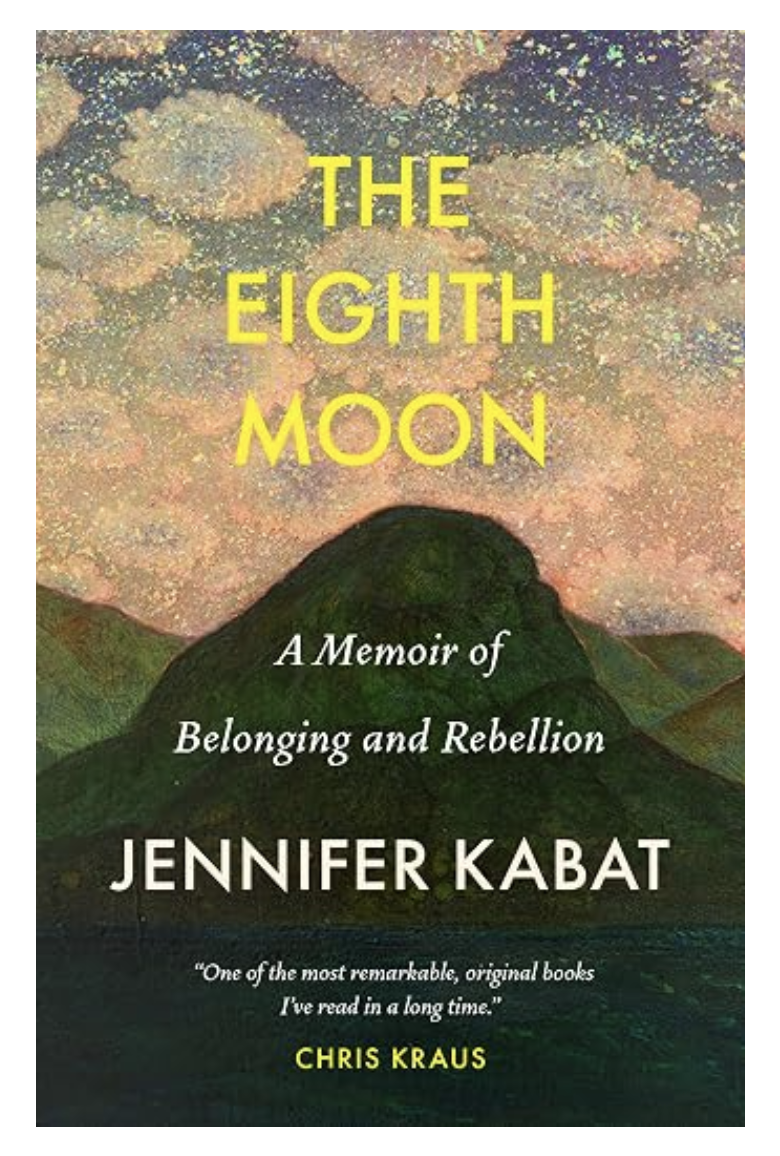
Jennifer Kabat's amazing 2024 memoir, The Eighth Moon conjures this scene in her first few pages, and she winds themes of land, solidarity, and co-operative movements through her entire book. Her subject matter, and her approach to it, make for a fascinating read.
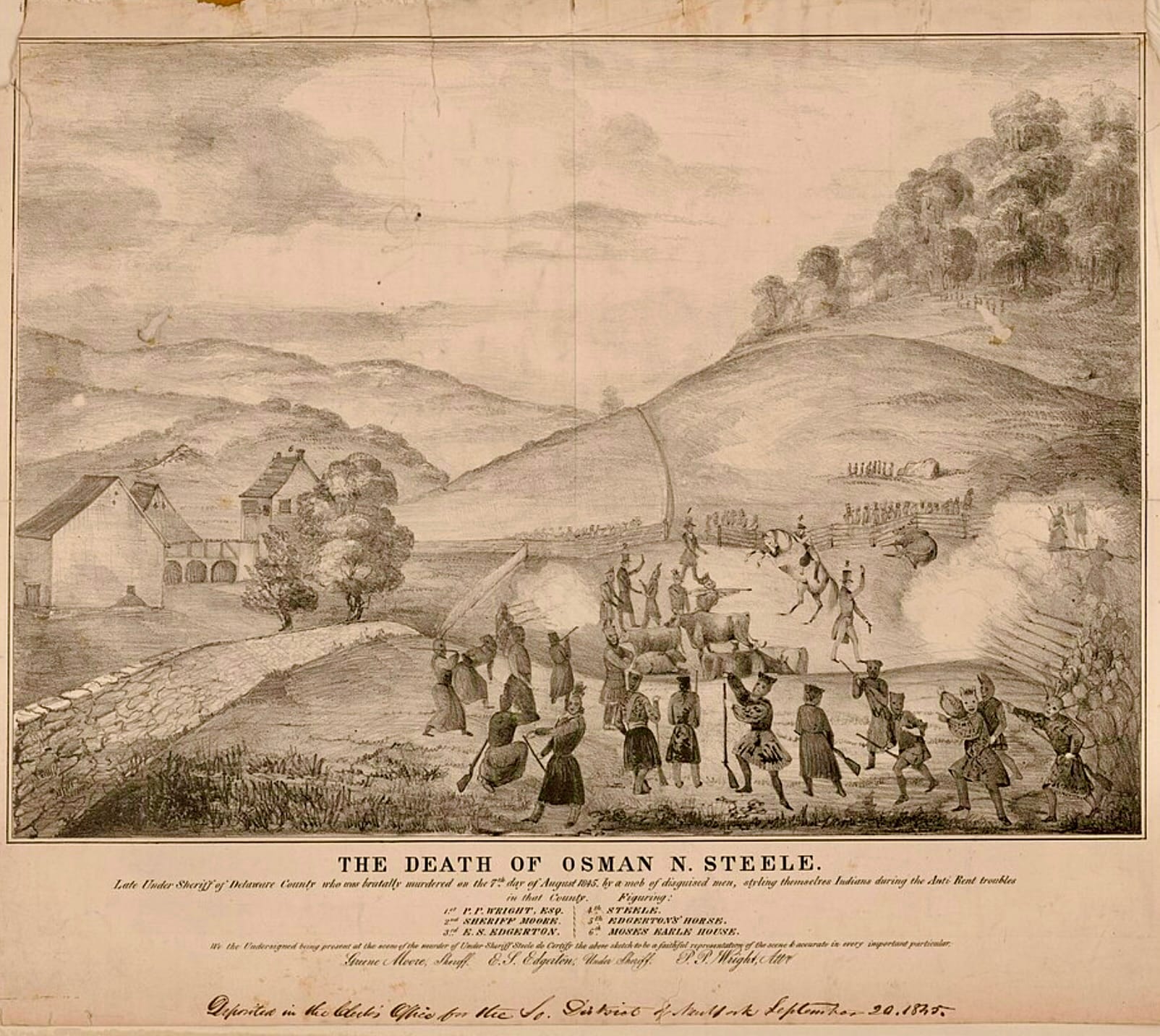
With these scenes in mind, stay tuned to find out how this time and place connects with my earlier posts, as well as with the inequities of today. If you have stories about how land or lack of it, rent, or debt have played a role in your family or town's history, I'd love to hear them.