Representations: What Shows Up in Our Stories, Art, and DNA

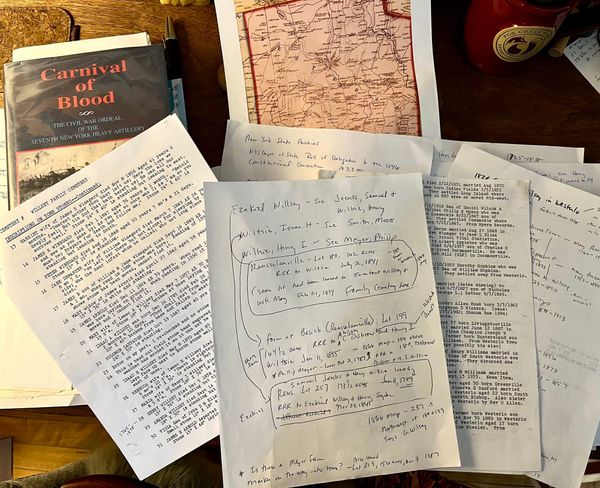
This week I've been following exciting leads, finding new and converging throughlines. Some of my excitement stems from what my DNA results reveal about my place in a much larger web. Ancestry.com's appropriately-named Thrulines option displays matches and compares trees. When shown in list form, it amounts to 4,000+ pages of people with whom I share a small portion of DNA. We all must have so many unknown cousins! It's been a little mind-boggling.
All this new information has me wondering about "knowability."
What can we know for certain about ourselves, our families, our country, our history? How much of what we think we know is more of a story we are constantly in the act of constructing?
Even purported facts are open to contestation and revision. I'm finding discrepancies as I trawl through information about my great-great grandfather, William Michael Gray and his brother Worship. The most significant involves when they left Ireland. This one is shaking me up a bit.
Given the sustained, horrific events of the Great Hunger, it makes a huge difference whether these children managed to leave by 1845. I'd been holding onto the idea, based on two relatives' accounts, that both got out before conditions in Ireland became absolutely desperate. Now I'm not at all sure.
This week, a 1900 census altered my whole picture. Census takers make mistakes—one recorded my grandfather Arby's name as Harvey—but the facts here look straightforward. The precise handwriting states that Worship arrived in 1847 (family account says 1843) and William in 1848. A 1917 obituary for William says he came at age 9 in 1849 (vs 1945).
If correct, contrary to the story I'd been telling myself, they did not "get out before things got really bad." I may even have located them on passenger lists: a William Gray, age 10 is recorded on the Andrew Foster in May, 1849 (though there's another one listed on the Stephen Whiting, age 9, 1846). A 13-year-old W. Gray is listed for June 2, 1847 on the ship Adam Lodge. This could well be Worship. Despite his distinctive name, he didn't show up on any passenger list searches using it.
As if this wasn't enough uncertainty, other elements can shape which facts we notice and what we do with them. Now that I know more about the famine and anti-Irish sentiments, William's story, written by his son William F. Gray, looks different. Dated 1952, it is a long look-back. He describes poor soil fertility at the small Cavan County farm. He mentions young William's work in the fields and herding geese.
But there is a deafening silence about the potato blight. The 1839 death of the father, Michael John, is unexplained. He describes the unnamed mother's demise only in relation to her son and husband: William "had reached the age of nine when his mother followed his father in death."
What had she died from? How were she and young William faring after his father's death, with his older brother gone, his sisters marrying and leaving for England and Australia with their spouses? Were they starving, and this fact was too painful, perhaps considered too shameful, to include?
On the family tree page she sent my father, even my great-aunt Virginia, William Michael's granddaughter, wrote only a single line referring to the famine: "Grandpa came to America as a cabin boy during the famine of 1845, age 9." In the scales of time we're considering, it's interesting to note that Virginia was born before her grandfather died. She passed away at age 100, in 2015.
So, besides the potential inaccuracy of facts and the selectivity with which they might be noted, emotions and attitudes are in the mix. How often do beliefs, myths and stereotypes influence our interpretations, even of our personal experiences? How do they filter into the workings of our imagination? These questions occupy the domain of the arts. They go to the core of what it means to represent our world, whether through story, song, or spectacle.
This week I felt drawn to see what a fiction writer would make of the appalling facts of the famine year called Black '47. I read Andrea Barrett's 1996 novella, Ship Fever. Using both actual and fictional characters, Barrett depicts the events of the massive Irish influx into Canada from the perspectives of an Irish immigrant, a Canadian journalist and his wife, and a newly-minted doctor who decides to work on the quarantine station at Grosse Isle. I was aware of taking it in on two different levels. First, I recognized when she incorporated news stories and first-person accounts I'd seen in my research. Despite heartbreaking gaps in the records of deaths and burials, copious historical documents do provide a solid basis for a fictional narrative.
But we often turn to fiction seeking a sense of participation in a world through the eyes of the characters, in effect, to be guided through another time and place through another's imagination. Centering the doctor's point of view does allow Barrett to convey the sheer horror and gruesome physicality of the Typhus outbreak, and how it overcame all attempts to contain it. But faced with the dynamics of class and gender, issues surrounding professionalization of medicine, and the politics of nativism and empire—as well as the sheer scale of starvation and disease—something similar happens with this form of fiction. How can the novella contain it?
To her credit, Barrett doesn't oversimplify the social scene. Her characters have flaws and mixed motivations, even while lacking the depth of development a novel might have allowed. She offers insights into the concerns of different communities—including Irish who had arrived years before—as the apocalyptic-level suffering reached their shores. But the magnitude of the Great Hunger threatens to exceed narrative capacity.
Writers, artists, and historians still grapple with how to convey something like this. Catherine Marshall's article looks at problems with contemporaneous depictions, showing how the art market, politics, and national stereotypes factored into production and reception of these works.
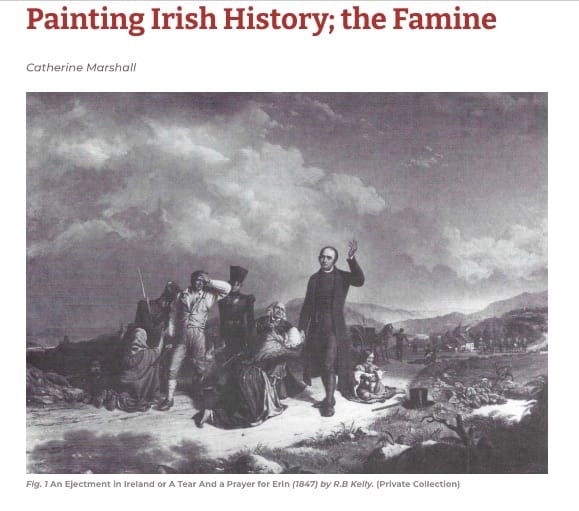
https://historyireland.com/painting-irish-history-the-famine/
Emily Mark-Fitzgerald's article offers a fascinating analysis of not only fine arts but also engravings from illustrated newspapers and the periodical press.
 Emily Mark-Fitzgerald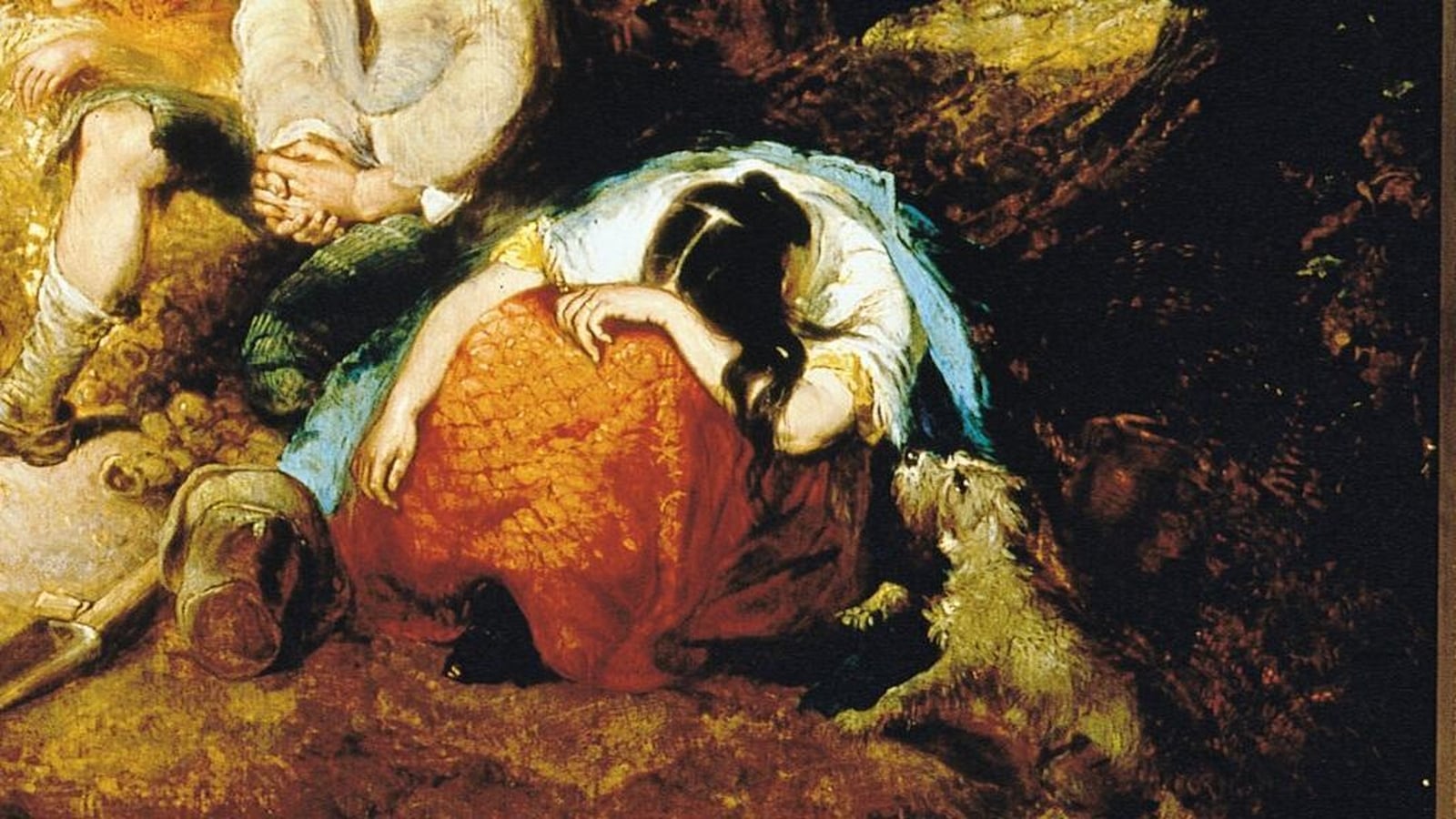
In 2018, an exhibition curated by Niamh O'Sullivan brought together historic and contemporary artists' responses. This RTE Radio piece is an interesting conversation about the complexities of the subject.
 Janet McKenzie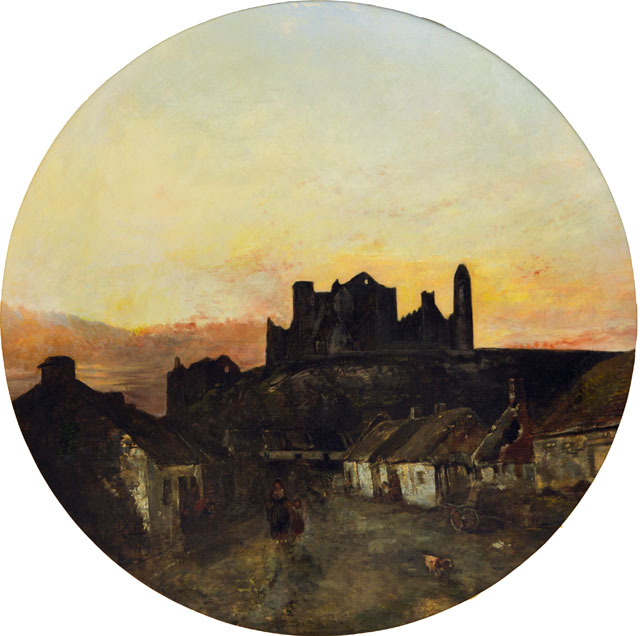


Finally, I'd like to explore a personal example of converging throughlines, and the workings of myth and stereotype on what we think we know.
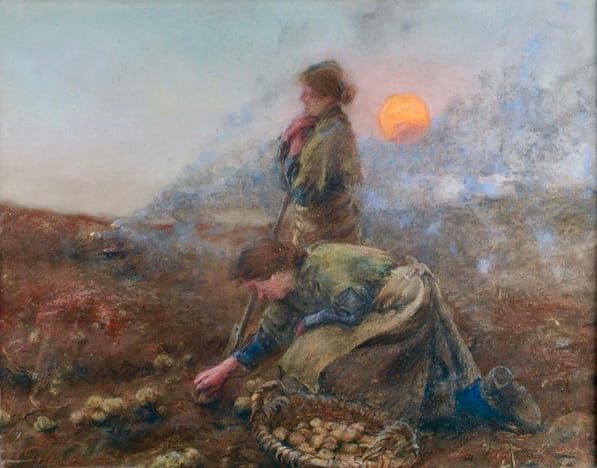
I'd visited Montreal's Black '47 graveyard before I discovered that William and his brother probably sailed during that period. The traumatic implications for them started to sink in, aided by depictions such as this one, of the close quarters, darkness, disorder, and crowding of an immigrant ship. But, in addition to evoking sympathy, how much did it also play into common assumptions about the squalor and poverty of the Irish people?
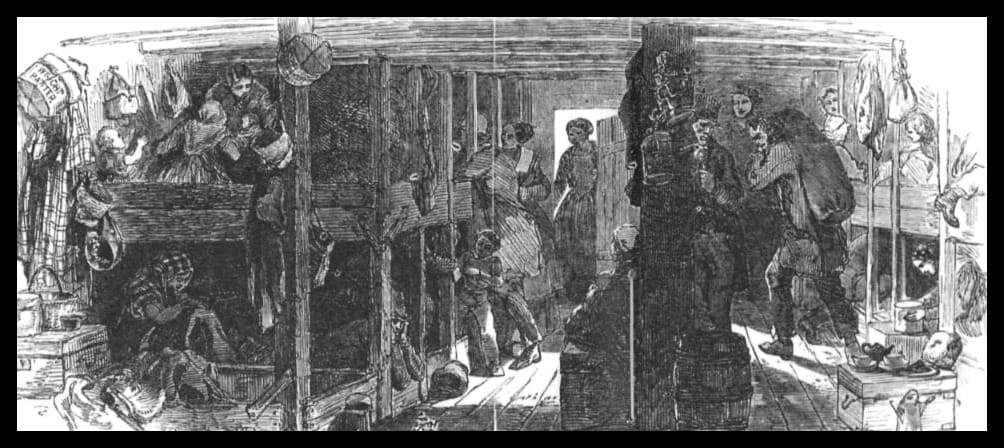
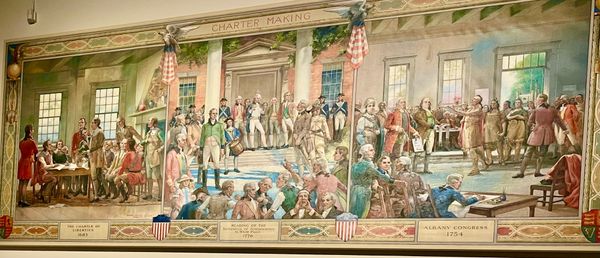
Then I realized that Black '47 was the very year that Dutch immigrants established my hometown. Seeking land and religious freedom, they too made a sea journey. I grew up seeing that origin story mythologized by this WPA mural in Pella's post office, a stark contrast with the London News image:
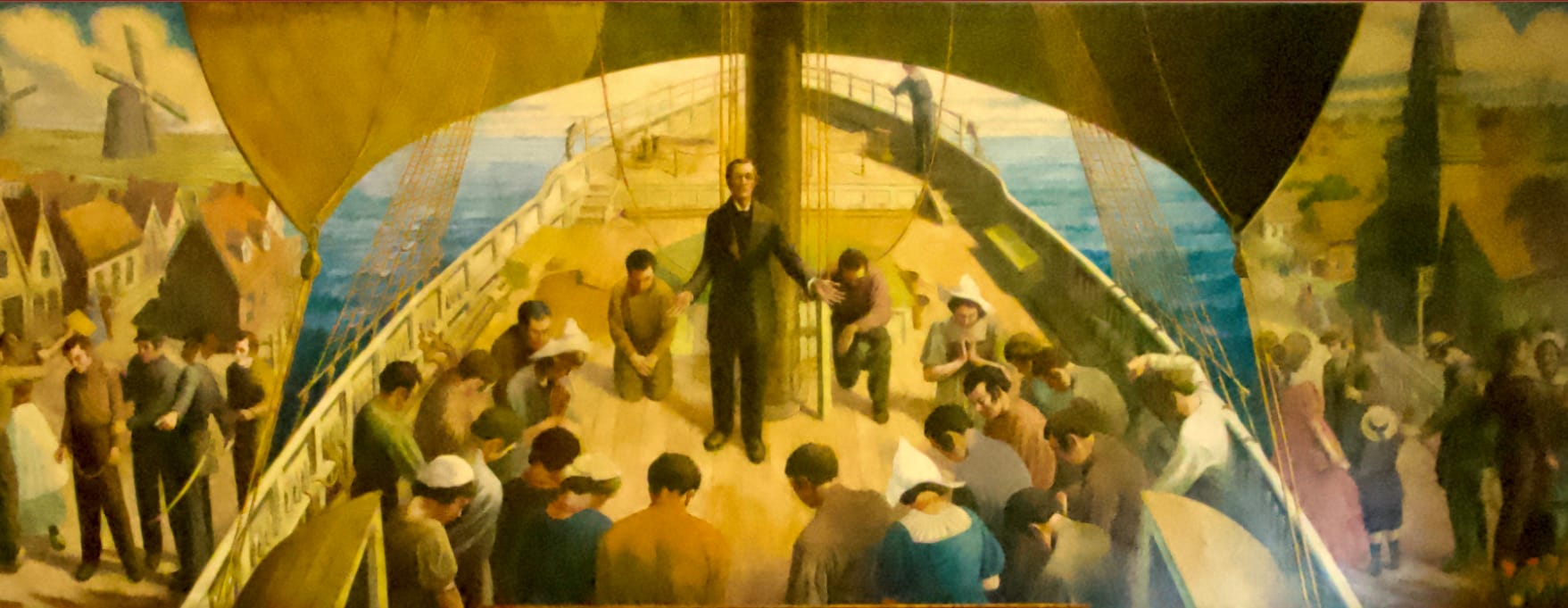
The group is clean, well-dressed, praying with their Dominie Scholte. The"before and after" panels on each side are clearer, here:

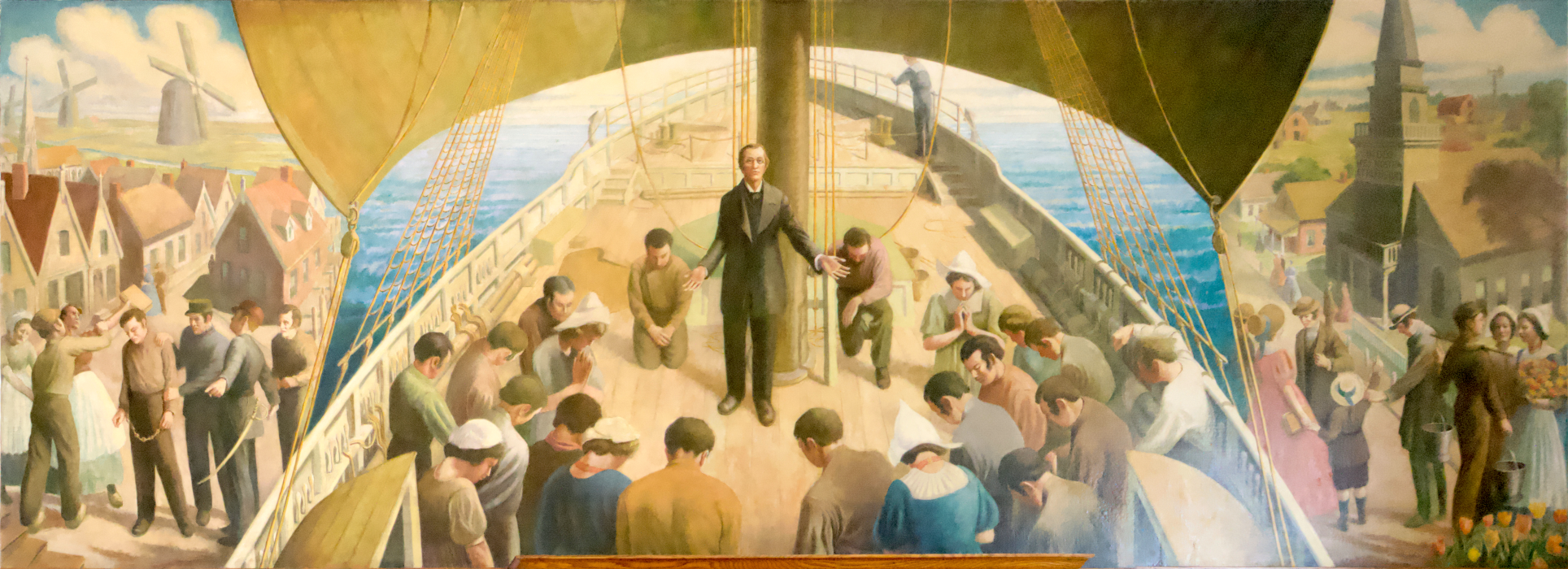
Stereotypes of the scrubbing Dutch are evoked, and even echoes of the "myth of the model minority," in this story told by Pella Historical Museums:
"Late in April 1847, the group set sail for America. Four ships in all sailed . . . the Catherina Jackson reached Baltimore in 26 days; the Nagasaki, 36; and another almost 60 days later. On shipboard, religious services were held daily, consisting mostly of psalm singing.
The ship’s cleanliness was not to Dutch standards. Almost immediately its inhabitants - both men and women - cleaned the ship from top to bottom. In fact, when landing in Baltimore, the immigrants’ ships were allowed to land without the usual inspections. The captains testified that they had never brought across the Atlantic more orderly or better behaved people." (https://www.pellahistorical.org/historyofpella)
Because of increased U.S. immigration restrictions, Irish immigrants to Canada were the worst-hit poor farmers and laborers. Canadian officials rationalized admitting them because they could be "used," working to settle the west. In that Typhus summer, though, many arrived too debilitated to work, and some were already classed as "paupers" in Ireland, incapable of working to support themselves.
The 1847 Dutch immigrants ranked higher in the class system. In fact, many Pella settlers later looked down on agricultural classes arriving from the Netherlands. Tellingly, Henry Lucas, in his 1945 introduction to a Dutch immigrant diary, hastens to assert, 100 years later, that:
"These immigrants . . . frequently possessed a rich culture; and for that reason in the process of becoming Americans they contributed to the new type of life developing in this country and not merely received something. Americanization, therefore, is not a unilateral process as has all too often been assumed."(https://penelope.uchicago.edu/Thayer/E/Journals/WiMH/29/Journey_from_The_Netherlands_to_Milwaukee*.html)
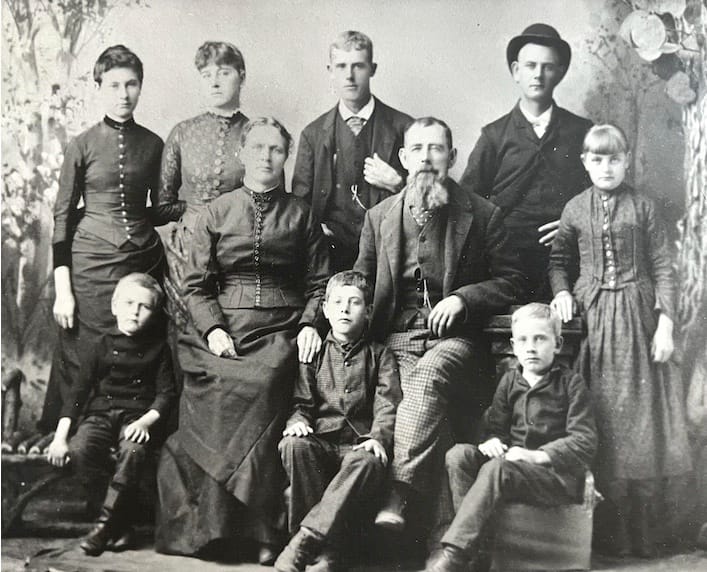
In light of such attitudes, the prosperous household presented in the Gray portrait, and the silence about famine in his son's account, raise questions. What social pressures shaped what he wanted known about the family? Raised in an Illinois farming community, William F. Gray went on to make a name for himself as a judge. As a subject of the Americanization process himself, he could talk about his father's chores in Ireland, but left out, I suspect, so much more.