Standing Together Against Adversity

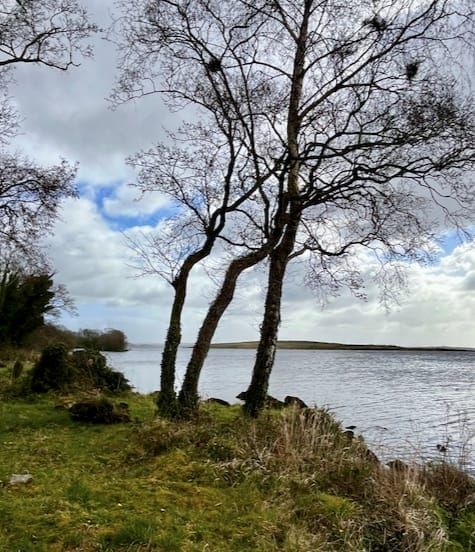
"Two ancient peoples. A modern-day connection. Nothing divides the Choctaw people from the Irish except for the ocean."
"Both the Choctaw Nation and Ireland were, in effect, colonized by outside powers. Their ancient tongues almost became extinct, and have been rescued from oblivion and made into working languages again through concerted effort and sophisticated approaches. Both peoples have successfully preserved their cultures and traditions." ChoctawNation.com
Last week I wrote about a family trip to Ireland, and the signs of mutuality between the Irish and the Choctaw that we came across on our travels. This week I'd like to further highlight this history, as it illustrates the important role of art in forging and honoring bonds of mutuality.
Two large metal sculptures commemorate the connection between the Choctaw and the Irish people. Both act as memorials and messengers: I knew nothing about the famine donation until I saw the Irish sculpture in a news article.
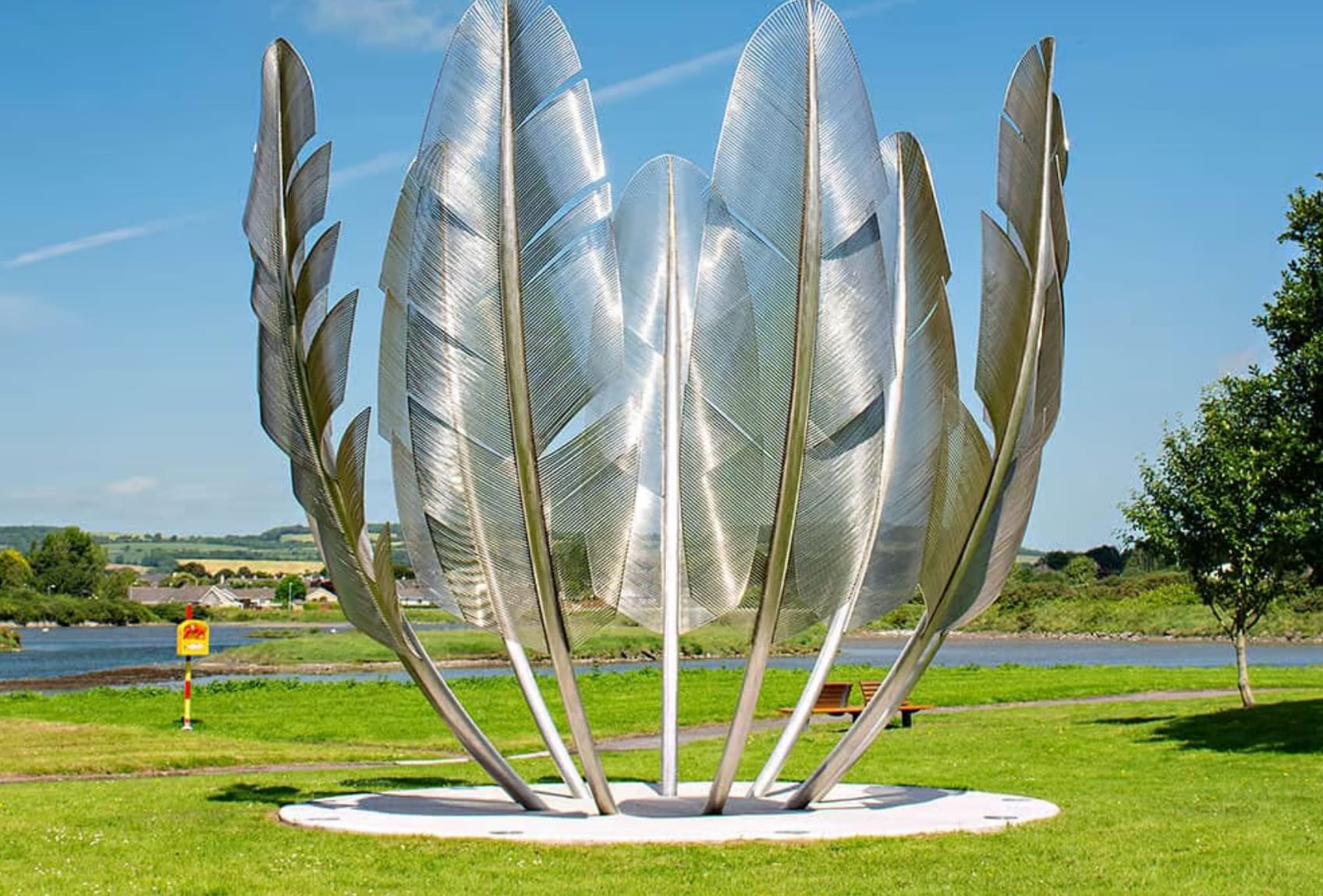
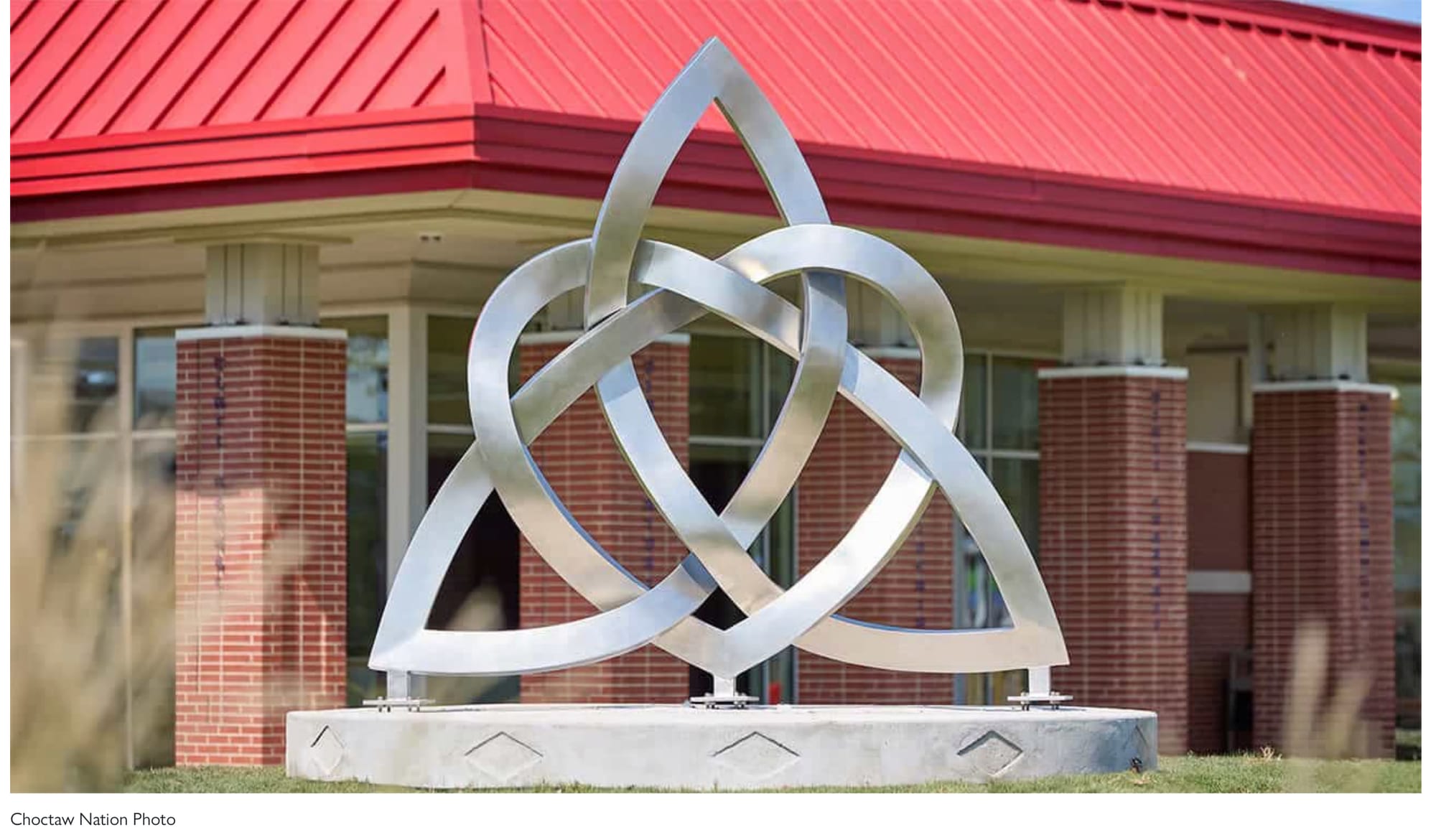
Left, Kindred Spirits, Ireland, right, Eternal Heart, Oklahoma (photos from Choctaw Nation website)
The first is Kindred Spirits (2015), located in Midleton, in Cork, Ireland. This ethereal stainless steel sculpture depicts a bowl-like circle of upright eagle feathers. Designed by Cork artist, Alex Pentek, it honors the Choctaw's 1847 gift of food aid. In the film below, Pentek discusses the details of its creation. He describes the process as being like making "a mandala in steel" and emphasizes that it conveys a larger message of "standing together against adversity."
Choctaw artist Samuel Stitt created the Eternal Heart sculpture, placed to face toward Ireland. You can see the short video about the 2024 unveiling here: https://www.choctawnation.com/news/chiefs-blog/chief-batton-unveils-eternal-heart-sculpture/ and the sculptor's perspective here: https://www.tiktok.com/@rtenews/video/7409364423539723552
Jake Wood's BBC article about the unveiling tells how Stitt had seen the Kindred Spirits sculpture in Ireland, and found it "very striking." He didn't stop at that, though:"But I thought to myself, 'so that's in Ireland—we should have a companion piece in Choctaw Nation."
Now Stitt "hopes the sculpture becomes a pilgrimage site as he is 'just amazed at how many tribal members go to Ireland specifically to see the Kindred Spirit.'"
 Jake Wood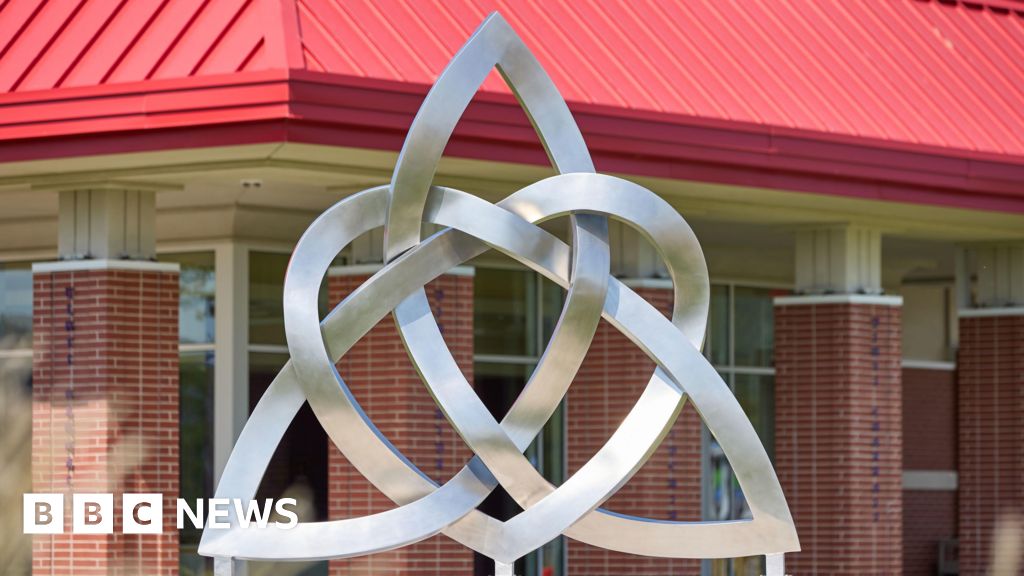
The famine gift history has inspired many other cultural exchanges and events. Members of both groups, including tribal and governmental leaders, have made visits and participated in walks memorializing the Great Famine and the Trail of Tears. An Irish-funded Covid aid donation was raised for the Hopi and Navajo. Through the Choctaw-Ireland Scholarship program, full tuition and a stipend are available for Choctaw students to study at University College Cork.
When Irish president Mary Robinson visited Oklahoma in 1995, they made her an honorary Choctaw Chieftain. In her speech at that occasion, Robinson lauded another Choctaw artist I'd like to highlight. As I wrote last week, I only learned of him when we came across one of his paintings in Donegal castle.
Waylon Gary White Deer had met Robinson while taking part in an annual Irish famine walk. As she tells it, his use of a metaphor made an impression on her: "He explained to me that taking part in that walk and remembering the past between the Choctaw Nation and Irish people and relinking our peoples is completing the circle."
Robinson saw how that circle could be expanded. She says, "I believe that we have in common that bond of humanity and it should be an additional reason why we should particularly reach out now to countries who suffer from poverty and hunger." (https://sites.uwm.edu/michael/choctaw-homepage/president-of-ireland-mary-robinson-addresses-the-choctaw-people/)
White Deer himself describes stumbling upon the story of the 1847 donation, when he was a kid in an Indian residential school. Sent to the school library to write a report on something of his choice, he found an account when he opened a 1934 history book to a page at random. He couldn't have foreseen how much that discovery would lead to the intertwining of his personal and professional life with the Irish people and landscape.
According to Helen O'Neill of the Cape Cod Times, there was little cultural memory of it on the Irish side either, as it "was largely forgotten until the 1990s when Irish researchers discovered references to it and other small donations from around the world during preparations for the 150th anniversary of the famine. Today, White Deer says the tribe's extraordinary act was 'like an arrow shot through time.'"
White Deer "knew little about Ireland," O'Neill writes, "other than 'they threw a big party for St. Patrick every year.' And then he met a group of Irish hikers at a tribal resort in Mississippi. He was working on an art commission. They had come to walk the historic "Trail of Tears," to worship at Nanih Waiya, and to offer a donation of $20,000 to the Choctaw nation.
White Deer was stunned. His own people commemorated the trail, but not like this, not with this determination to learn from the past and act on it."
HELEN O’NEILL, Cape Cod TimesWhite Deer covers a lot of fascinating ground in the 2024 interview with Thomas Pool below. He explains how his style of painting is influenced by the "Traditional Indian Art style, which is a little bit like Byzantine or Ancient Egyptian art, that kind of flat, two-dimensional work with subjective use of colour." He elaborates on the experiences and influences Ireland has offered him, and the collaborative projects he has worked on there. These include other community aid projects, music, and film.
"A way to see things I hadn't seen before"
He also explains how being in Ireland has expanded his vision:
"I find Ireland to be an oasis, for me, where I can find a sense of decency and humanity that I often find lacking in America. It gives me an ability to look at my people, and their struggle with colonisation, and compare it, not just to that of Ireland, which was also colonised, but to other places in the world. So Ireland has given me a way to see things I hadn't seen before."
Thomas Pool
White Deer's Irish experiences relate directly to his artistic values:
"I think if you're a visual artist that you should extend your vision to the world around you, you know? If you can focus on a very small area, maybe for weeks at a time, you should be able to macro your vision to the world around you and do something good for the world. And that's what I always try to do . . . that's what Ireland gave me as a gift. A gift to see beyond myself, my tribal nation, and our small communities, and see that there's a greater kinship that we all have. That we're all the children of the same Mother Earth. That's the gift that Ireland gave me."
Pool's article also features many fine examples of White Deer's work, and is well-worth checking out.
The following article covers more about his work with commemorative walks and the Famine Landscape Project.
Audrey Watson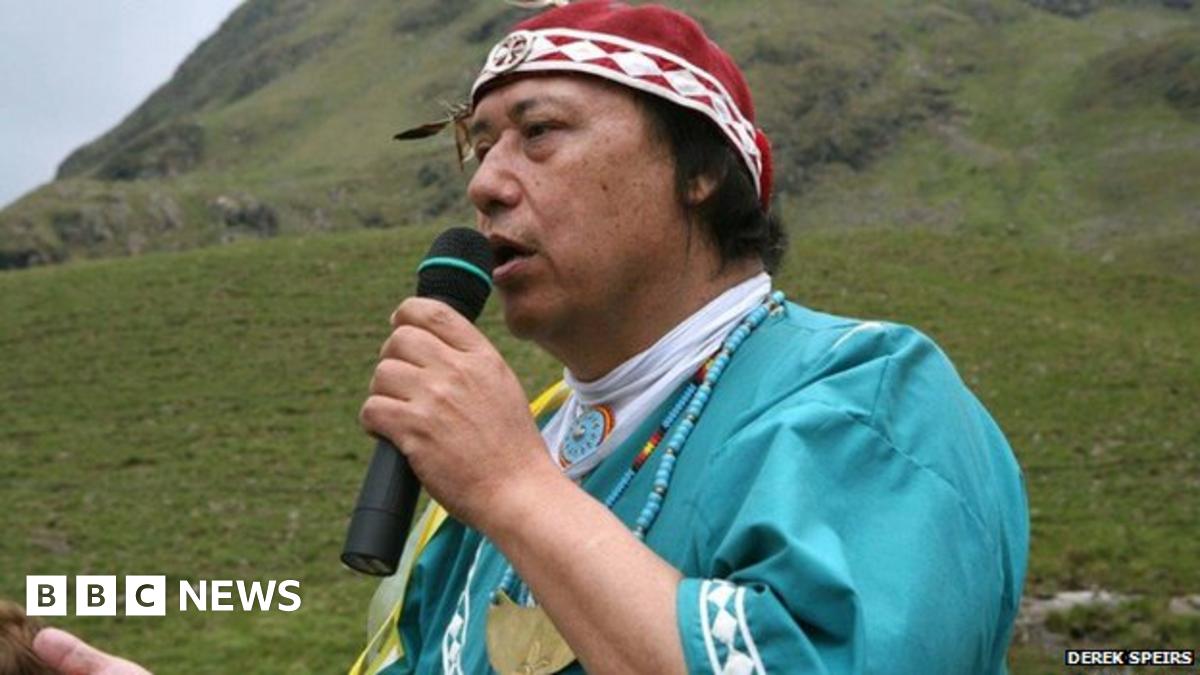
"There is a teaching among the Choctaw" White Deer states, "that says feeding someone is the greatest thing you can do because you are extending human life."
That is a powerful realization. A meal offered is an extension of life.
Just as I was finishing this post, I found additional evidence of the positive ripple effects of both the gift and the memorializing of it in art. Here's a video about Brendan O'Neill's 2024 sculpture, made for the Irish National Famine Museum:
There are so many ways we can stand together against adversity. So many ways that small gifts given personally or collectively can act as arrows through time—supporting lives, offering inspiration, bringing beauty amidst suffering, and seeding connection and collaboration.