Post 49: Who Lives Here? Stories Differ When Nations Collide

This week I'm writing early, then taking a short break to attend a family wedding in Northern Ireland. Today's post is a gathering of a different kind—of letters, maps, and memorials—documenting a contested past that lives on in the present.
In the spring of 2024, I drove from New York to Illinois, researching a cicada project I've been working on. Traveling west on Rt. 86, the Southern Tier highway, I encountered two stories of the country, encapsulated in two rest areas. The first, was on a weathered sign, erected in 1969 in Erwin, NY.
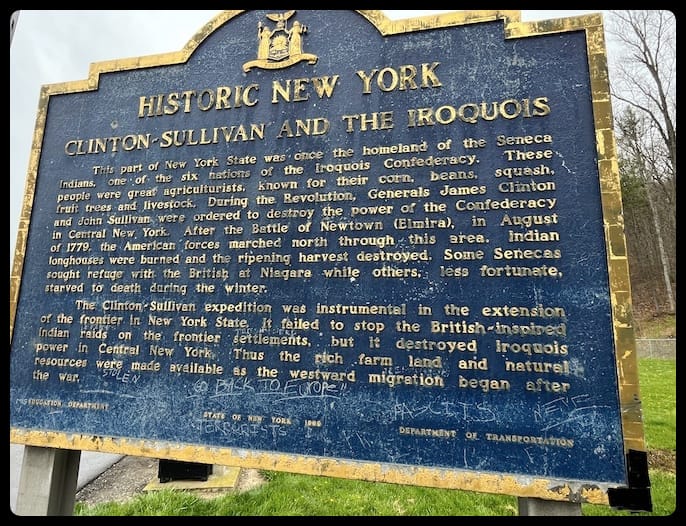
The inscription reads:
"This part of New York State was once the homeland of the Seneca Indians, one of the six nations of the Iroquois Confederacy. These people were great agriculturalists, known for their corn, beans, squash, fruit trees and livestock. During the Revolution, Generals James Clinton and John Sullivan were ordered to destroy the power of the Confederacy in Central New York. After the battle of Newtown (Elmira), in August of 1779, the American forces marched north through this area. Indian longhouses were burned and the ripening harvest destroyed. Some Senecas sought refuge with the British at Niagara while others, less fortunate, starved to death during the winter.
The Clinton-Sullivan expedition was instrumental in the extension of the frontier in New York State. If failed to stop the British-inspired Indian raids on the frontier settlements, but it destroyed Iroquois power in Central New York. Thus the rich farm land and natural resources were made available as the westward migration began after the war."
The neutral tone is in striking contrast with the horrific facts. The passive voice is also glaring, along with the omission of who gave the orders. Then there's the upbeat ending from the settler perspective. Two hundred years later, the Seneca are spoken of as if they no longer exist. I wondered what kids growing up in New York were taught about this.
I'd learned about it through a cicada connection. George Washington ordered this scorched earth campaign. When periodical cicadas emerged on their land the following spring, the starving Onondagas rejoiced. Though dwindling, this brood still exists; the Onondaga still give thanks for having been able to eat them.
 Onondaga Nation
This map lays out the paths of the burning.
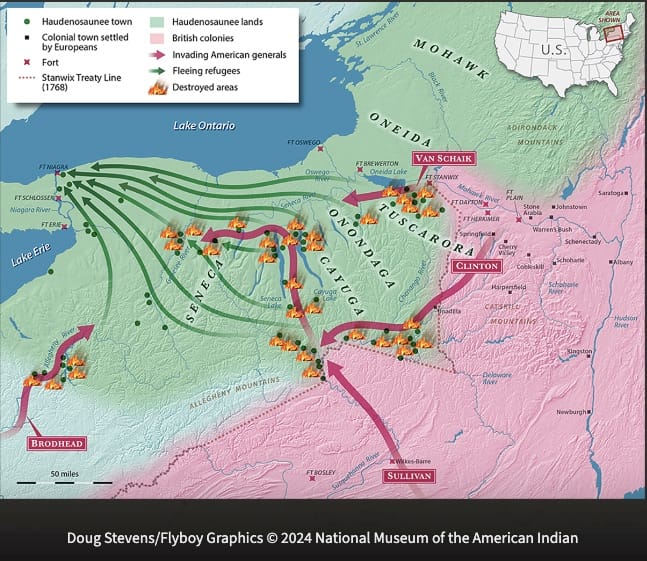

The soldiers were surprised by what they found:
"Many of the troops were shocked . . . They found not the crude bark huts or longhouses of "Savages," but instead orderly rows of houses built of hewn timbers and frame houses with windows . . . Many of these Indian villages rivaled or surpassed the towns that the soldiers had come from.' https://www.nps.gov/articles/000/the-clinton-sullivan-campaign-of-1779.htm
The brutal letters between generals offer a fascinating lens. The campaign was delayed by issues around troop movement (road-building), food (procuring enough provisions was a bone of contention between Washington and Sullivan), and even clothing (the men lacked shirts). But Washington was unwavering in his plans and his commitment to disproportionate force.
In his letter of May 31st, 1779, he told Sullivan the expedition was "directed against the hostile tribes of the six nations of Indians, with their associates and adherents.1 The immediate objects are the total destruction and devastation of their settlements and the capture of as many prisoners of every age and sex as possible. It will be essential to ruin their crops now in the ground and prevent their planting more."
Washington was unequivocal, demanding thoroughness: "parties should be detached to lay waste all the settlements around with instructions to do it in the most effectual manner, that the country may not be merely overrun but destroyed."
He added explicit instructions as to troop behavior. It should be "attended with as much impetuosity, shouting and noise as possible, and to make the troops act in as loose and dispersed a way as is consistent with a proper degree of government concert and mutual support—It should be previously impressed upon the minds of the men wherever they have an opportunity, to rush on with the war hoop and fixed bayonet—Nothing will disconcert and terrify the Indians more than this."
Peacemaking during the process was explicitly forbidden:
"you will not by any means listen to ⟨any⟩ overture of peace before the total ruin of their settlements is effected . . . " (George Washington to Major General John Sullivan, 31 May 1779,” Founders Online, National Archives, https://founders.archives.gov/documents/Washington/03-20-02-0661. All further references are to this source.)
By August 15, Sullivan began conveying happy missives, starting with the destruction at Chemung:
"it was most beautifully situated, contained a chappel with between thirty and fourty other houses, many of them very large, and some tolerably well finished. There were fields of corn, the most extensive that ever I saw, with great quantities of pota⟨toes,⟩ pumpkins, squashes, and in short every other thing which any farms could produce—the whole of which was destroyed root and branch."
He commends his soldiers' work: "Our troops having completed the business returned the same evening to camp, having performed a march of at least fourty miles in less than twenty four hours, besides going thro⟨ugh⟩ the fatigue of destroying those extensive fields the whole of which they performed with the great⟨est⟩ chearfulness. "
Two weeks later, in Newtown, he again finds "extensive Fields of the best Corn and Beans so extensive and numerous as to keep the whole Army this day industriously employd in distroying and the business yet unfinish’d."
On September 15, Washington reiterates:
"I would mention two points which I may not have sufficiently expressed in my general instructions, or if I have, which I wish to repeat. The one is, the necessity of pushing the Indians to the greatest practicable distance, from their own settlements, and our frontiers; to the throwing them wholly on the British enemy. The other is, the making the destruction of their settlements so final and complete, as to put it out of their power to derive the smallest succour from them, in case they should attempt to return this season."
I quote Sullivan's September 28 tally in depth. He clearly meant to allay any doubts. He displays a disorienting admiration for the villages while dispassionately describing their obliteration:
". . . this Town of Konadahee consisted of 20 houses, very neatly built and finished, which we reduced to ashes; and the army spent near a day in destroying the corn and fruit trees, of which there was great abundance; many of the trees appeared to be of great age . . . . the residue of the Army was employed in destroying the Corn at Kanasedagea, of which, there was a large quantity.4
This town consisted of 50 Houses and was very pleasantly situated, in it we found a great number of fruit trees, which were destroyed with the town. The Army then moved on, and in two days, arrived at Kanandaique, and were joined on the Road by the detachment sent on the West side of Seneca lake, it having been almost two days employed in destroying the Crops and settlements there—At Kanandaique we found 23 very elegant Houses, mostly framed, and in general very large. We also found very extensive fields of Corn, which having destroyed we marched to Honyaye, a small town of ten Houses which we also destroyed . . .
. . . we reached the Castle, which consisted of 128 Houses mostly very large and elegant. The town is beautifully situated—almost incircled with a clear flat, which extends for a number of Miles, on which were the most extensive fields of Corn, and every kind of Vegetable, that can be conceived. The whole Army was immediately engaged in destroying the Crops—The Corn was gathered and burnt in Houses and in Kilns, that the Enemy might not reap the least advantage from it, which method we have pursued in every other place . . ."
Meanwhile, he reports,
Col. Butler destroyed in the Cayuga Country five principal Towns and a number of scattering Towns, the whole making about 100 in number exceedingly large & well built—He also destroyed 200 Acres of excellent corn with a number of orchards one of which had in it 1500 fruit Trees—another Indian settlement was discovered near new Town (by a party) consisting of 39 new houses which was also destroyed. The number of Towns destroyed by this army amounts to 40 besides scattering houses—the quantity of Corn destroyed at a moderate computation must amount to 160,000 Bushls with a vast quantity of vegetables of every kind—"
He reassures Washington that "Every creek & river has been traced and the whole Country explored in search of Indian settlements, & I am persuaded except one Town situated near the allegany about 57 Miles from Chenessee—there is not a single Town left in the Country of the five nations."
Sullivan cannot resist a gloating P.S.:
"I am happy to find that your wishes therein expressed were anticipated as there is not at this time even the appearance of an Indian on this side the Chenessee and I believe there is not one on this side Niagara, nor is there any kind of sustenance left for them in this Country."
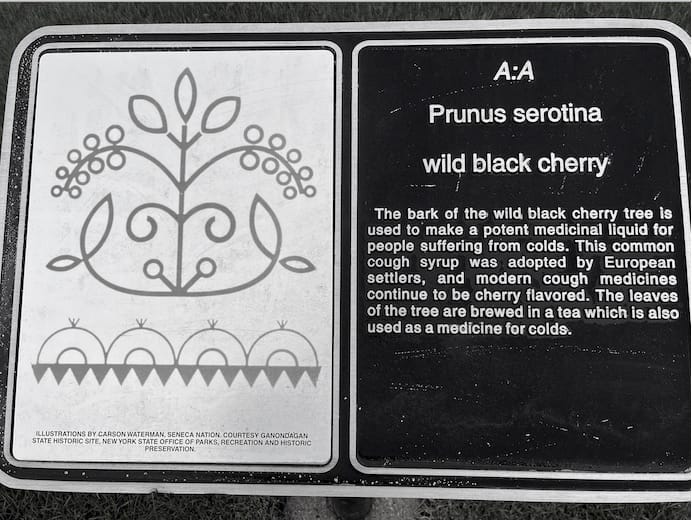
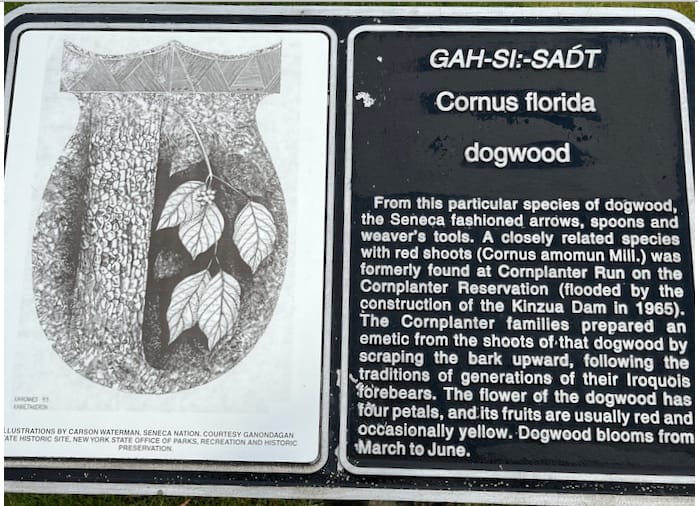
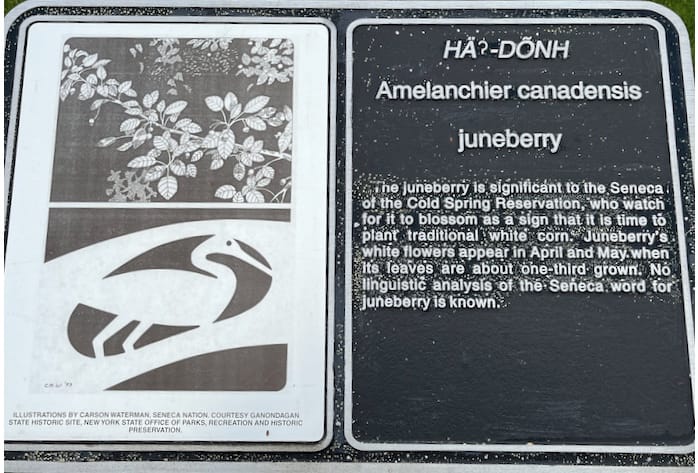
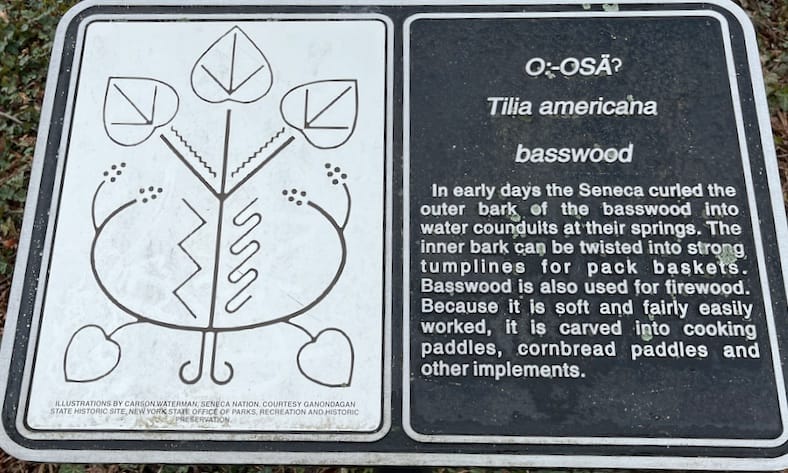
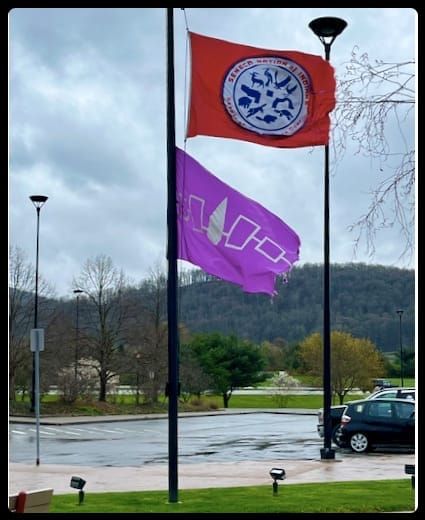
But the Seneca shall have the last word here. Carson Waterman's (Snipe clan) plant depictions adorn the second rest area, in Allegany. Through use of past and present tense, these tell a longer story.