So That All May Eat
"Even before the famine began, a writer in the Daily Picayune had used Ireland as a benchmark for misery across the British empire, contending that 'the condition of the most abject slave in the Colonies is, in my opinion, better far than that of the unfortunate Irish peasant.'" A. Hanson Shrout, Aiding Ireland: The Great Famine and the Rise of Transnational Philanthropy
In 1847, when the Charleston Hibernian Society of South Carolina kicked into high gear to raise funds for the Irish famine, the Quaker Central Relief Committee faced a moral dilemma. A high number of donors were enslavers.
Richard Allen, member of the Dublin Society of Friends, addressed a letter to the committee, urging them to "turn away 'these blood-stained contributions.'" Noting that the "'white population numbers about two hundred thousand, whilst there are about three hundred thousand slaves,'" Richard Allen "concluded that his colleagues must acknowledge that the 'greater portion of money that comes from South Carolina in particular must come from slaveholders' or people who benefit from and perpetuate slavery" (Shrout, 125).
Allen was proven right: "contributions from men who held people in bondage accounted for nearly 70 percent of all funds collected." His prediction that the enslavers would use their donations to proclaim their moral superiority was also correct. However, given the extremity of the need and the lives at stake, the Relief Committee accepted the donations.
That these wealthy donors sought to capitalize on the famine to promote the myth of the humane plantation owner isn't surprising. But they went an unexpected step further. Southern enslavers claimed common cause with those dying of starvation. Shrout cites South Carolina newspapers in which writers expressed solidarity by lauding Irish compatriots who fought in the American Revolution. They then had the audacity to draw parallels, comparing the Southern slaveholders' fight against the abolitionist North with the plight of the Irish under the British government.
Thus, the slaveholders identified themselves as the good guys—for feeding their slaves—and as the victims of perceived government tyranny and overreach.
In a strange twisting of the facts, they argued that the growth of the Black population in the state was proof of goodness: "In July 1847, the Charleston Mercury argued that slavery could not be inhumane or unchristian, because the population of Black people enslaved in the South 'are increasing in much greater ratio than the Whites'"(129).
Something similar is happening today. Obscenely wealthy, oppressively powerful whites, posing as good guys and victims. Here's how Elon Musk's father Errol responded, when an interviewer remarked on South Africa's history of oppressing Blacks:
"'No! How do you oppress? We gave them work, we fed them. They grew from a tiny little group into a massive group. That's not oppression, that's feeding them! You only grow big if you get fed. You only start at 800,000 and become 50 million if you get fed! We fed them, for crying out loud! You know, enough with this nonsense,' Musk claimed, conflating demographic growth with a denial of human rights abuse."
 Earnest Daniel Nicolas
Both father and son identify as the victimized group, arguing whites are threatened with being replaced by people of color. According to others of his ilk (including our president), white European culture is under attack by hostile, dangerous, and even murderous people of color. Dismissing actual history as "nonsense," Errol lays claim to an imagined, historic act of noblesse oblige, in which his class has provided life-giving sustenance.
Errol's repetition of the words fed and feeding is bizarre. Especially given his son's feeding boast just months earlier:
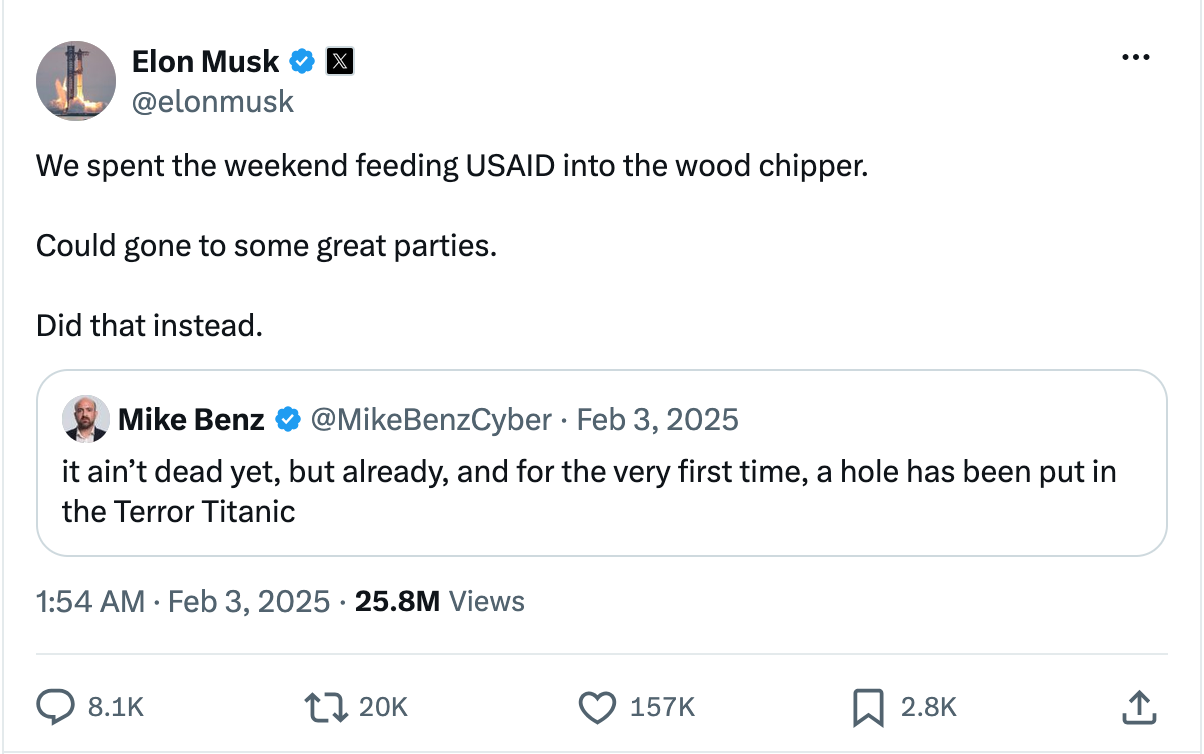
Claiming to be cutting all things "woke" from the system, the younger Musk essentially cut off life-support programs, among them, funds for severely malnourished children.
Jake Johnson reported on the devastation this had caused by June of this year:
“'The impacts of the cuts were immediate and tragic,' Nicholas Enrich, a former USAID employee who became a whistleblower, wrote in The Boston Globe on Friday. 'Health clinics and emergency ambulance services shuttered overnight. Clinical trials were deserted. Thousands of healthcare workers lost their jobs. Lifesaving food and medicine was left to expire in warehouses. According to conservative estimates, in the year since USAID was dismantled, 750,000 people have died as a result of the cuts. For the first time in a generation, more children died in one year — 2025—than in the previous year.'” (https://www.commondreams.org/news/elon-musk-usaid-famine)
One of the resources hit hard by these cuts is RUTF, or ready-to-use therapeutic food. This nutritional paste has been helping children recover from severe acute malnutrition throughout the past 30 years. Shelf-stable, lightweight, and requiring no water, RUTF is simple to use for populations lacking access to clean water and medical facilities.
It works. When children can eat RUTF consistently during treatment, most begin to show weight and health gains within as little as a month and a half.
This recent NPR report on the ground in Senegal describes the enormity of the problem, as it affects 1 in 10 children there:
"About half of the mortality of children under 5 is related to malnutrition," says Ndèye Astou Badiane, country director in Senegal for Helen Keller Intl, a nonprofit that addresses this issue." (https://www.npr.org/2026/06/13/nx-s1-5787791/malnourished-children-senegal-therapeutic-food-plumpynut)
The non-profit organization, Action Against Hunger, has been at the forefront of research, development, and distribution of RUTF. They assist clinics and train community health workers to identify need and offer support. They also continuously adapt, seeking to make this life-saving food more affordable and accessible, by finding ways to source and manufacture it closer to the locales in most need. It is just one of many efforts they've been making to improve conditions around the globe.
You can learn more, as well as donate, here. A little goes a long way:
 Kara Green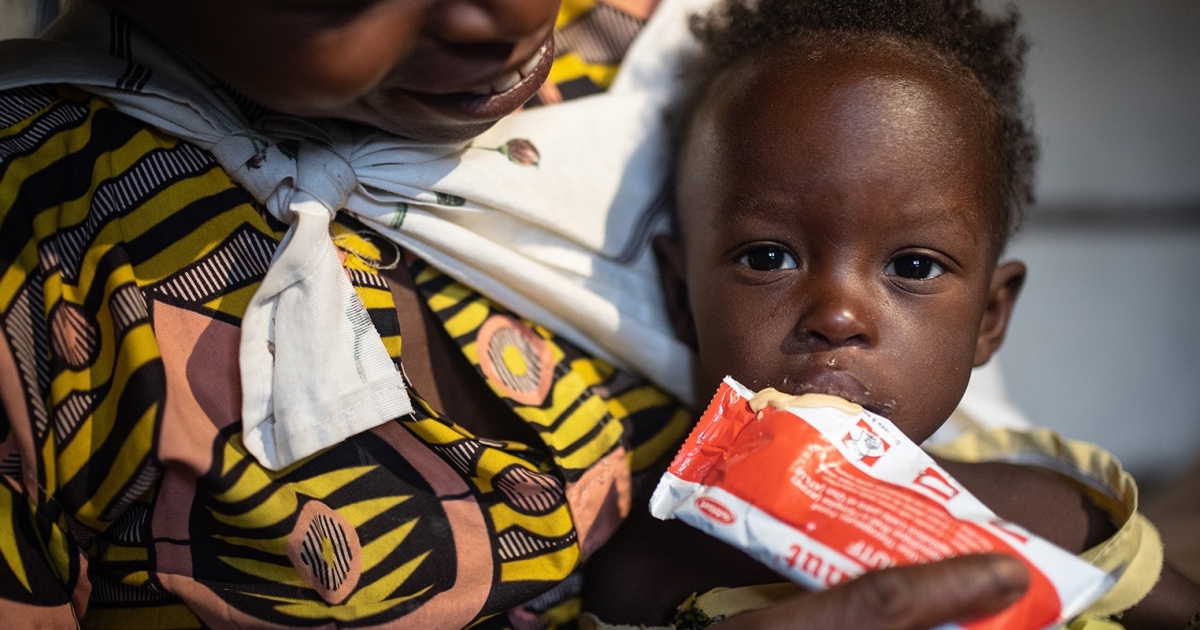
Unicef has long supported the distribution of RUTF as well. The small, pre-packaged servings of RUTF make it easier to supply to remote locations, such as villages in Nepal where it must be packed in on donkeys. You can find out more here: https://www.unicefusa.org/stories/30-years-rutf-meet-people-behind-lifesaving-innovation
If you can, please help me spread the word about the importance of contributing to RUTF. We can help save lives if we each take action.
And, to complete all three parts of my Learn, Imagine, Act project, I'd like to end with this quote from Johnson:
"Oxfam has estimated that a 10% tax on Musk’s $1 trillion fortune would generate enough revenue to end extreme poverty worldwide for a year."
Imagine. That's some blood-stained money I'd be happy to see put to good use.