A Country in Danger

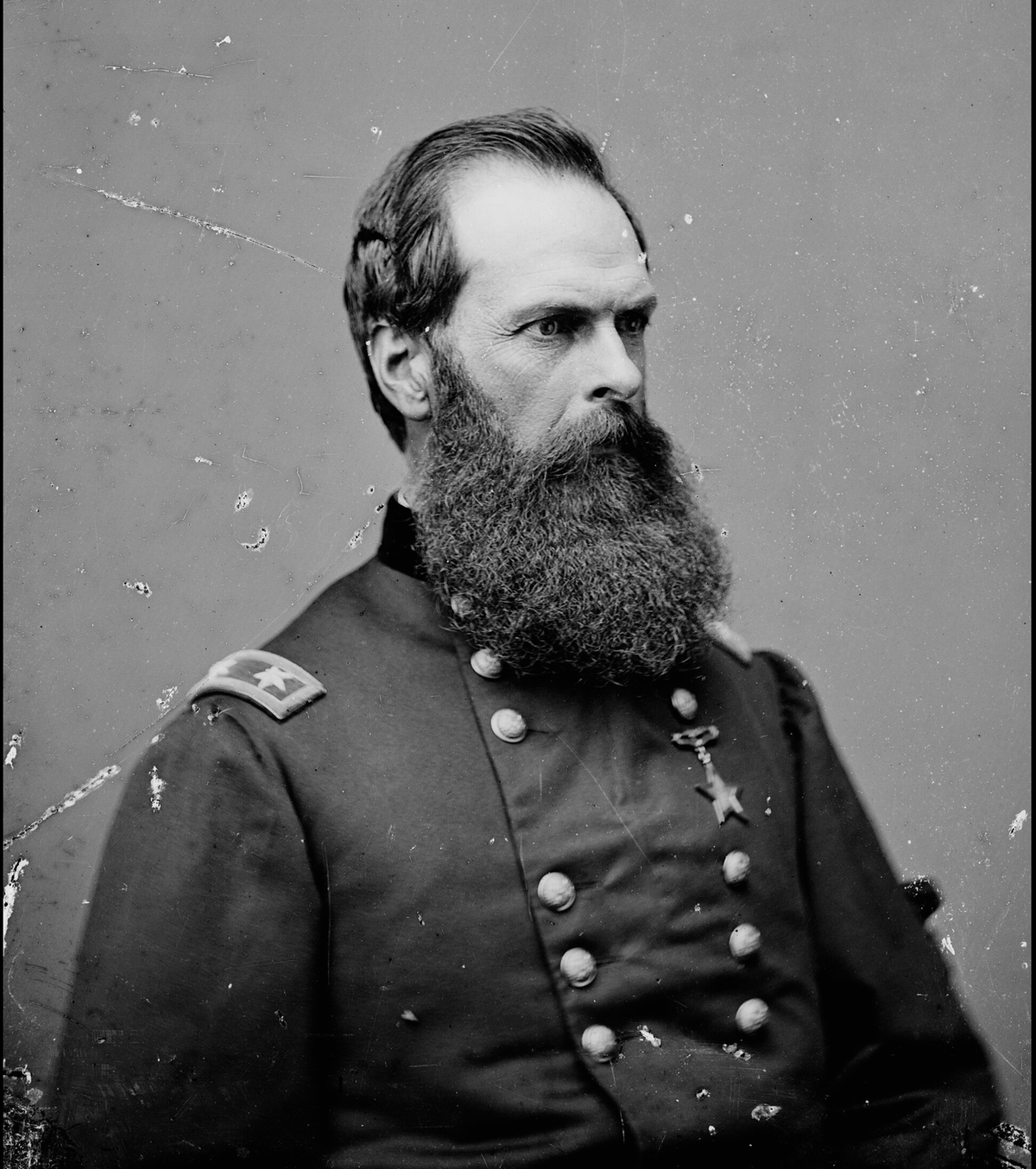
"Was with Buel most of the day. He thinks a great deal of home but wishes to see this rebellion ended as bad as I do. Hurrah for the Stars & Stripes, long may they wave oer the land of the free & home of the brave. Aint I patriotic though. Well I don't know as I am sorry that I enlisted fer I would be ashamed to know that my country was in danger & I not willing to give my aid in bringing peace to the land again." Berea Willsey, April 14th, 1862
I've just finished reading the Civil War diary kept by a grandparent's cousin from 1862-64. It was intriguing, but also brought me face-to-face with my own ignorance, again. Besides causes, dates, and major figures, I have little specific knowledge about the Civil War. As with so many subjects in my Learn, Imagine, Act project, I found myself asking, "what was I actually being taught about during all those years in school, instead of this?"
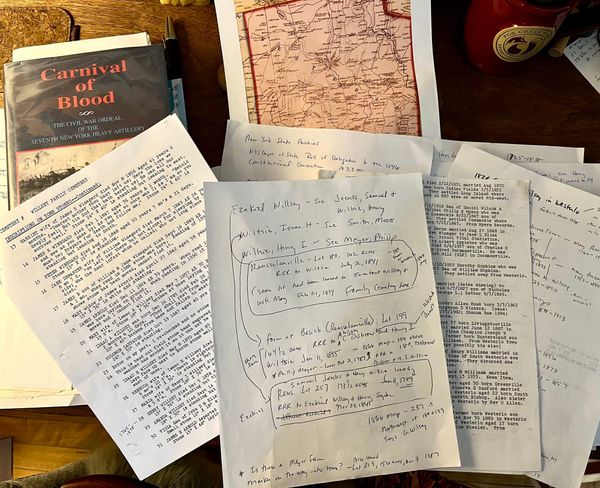
As I've mentioned, my family didn't pass along many ancestral stories. So, I'm attempting to construct a narrative from scattered bits and pieces, and what a compelling treasure hunt it is! Compared with the little I did learn in school, it's amazing how different it feels to encounter historical facts through making acquaintance with my forbears.
It's the most mind-blowing "homework" ever. The process is anything but linear, and each clue draws with it another question or mystery.
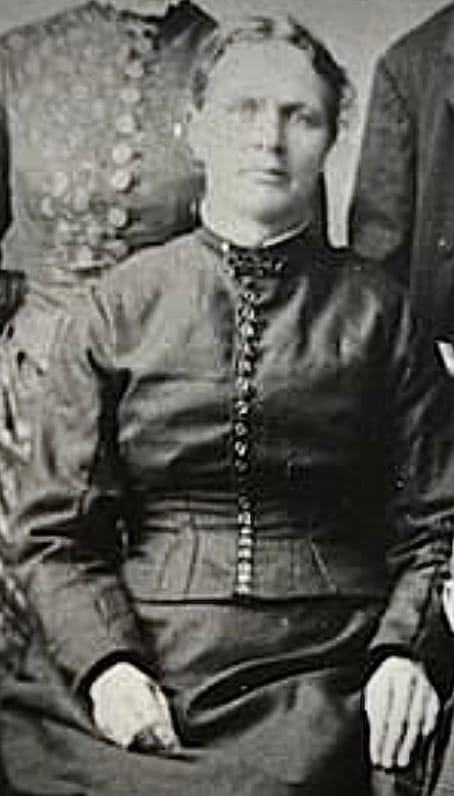
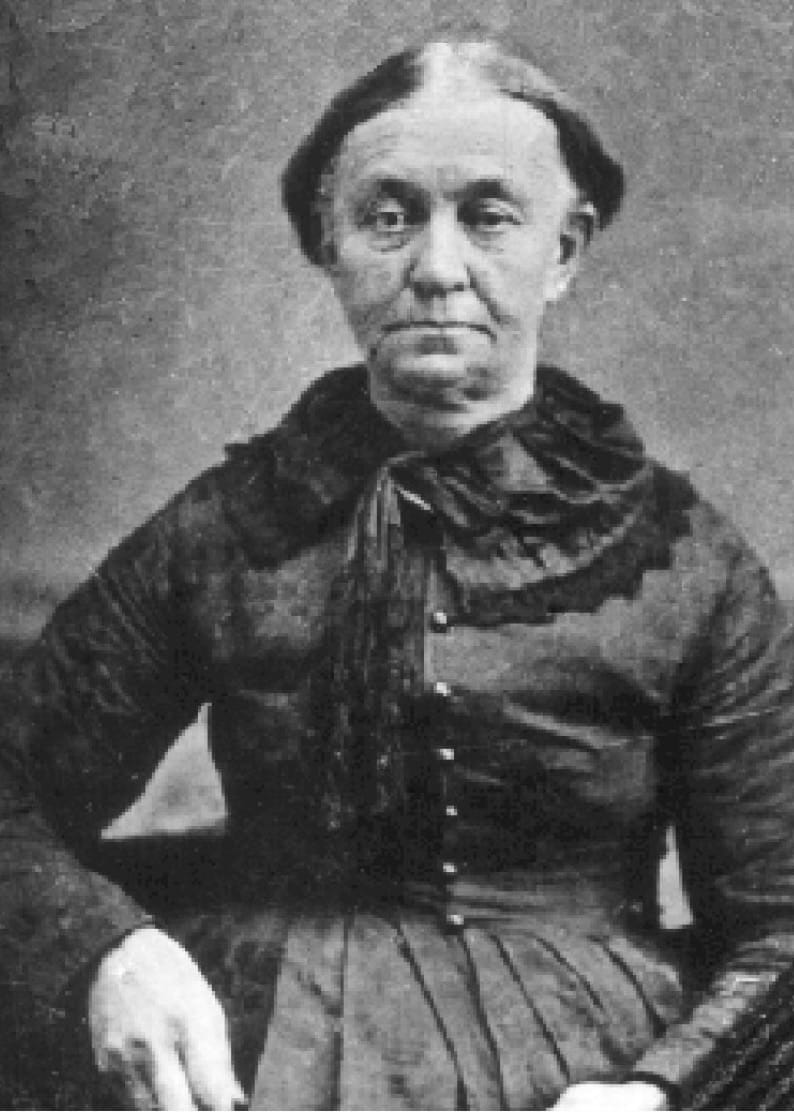
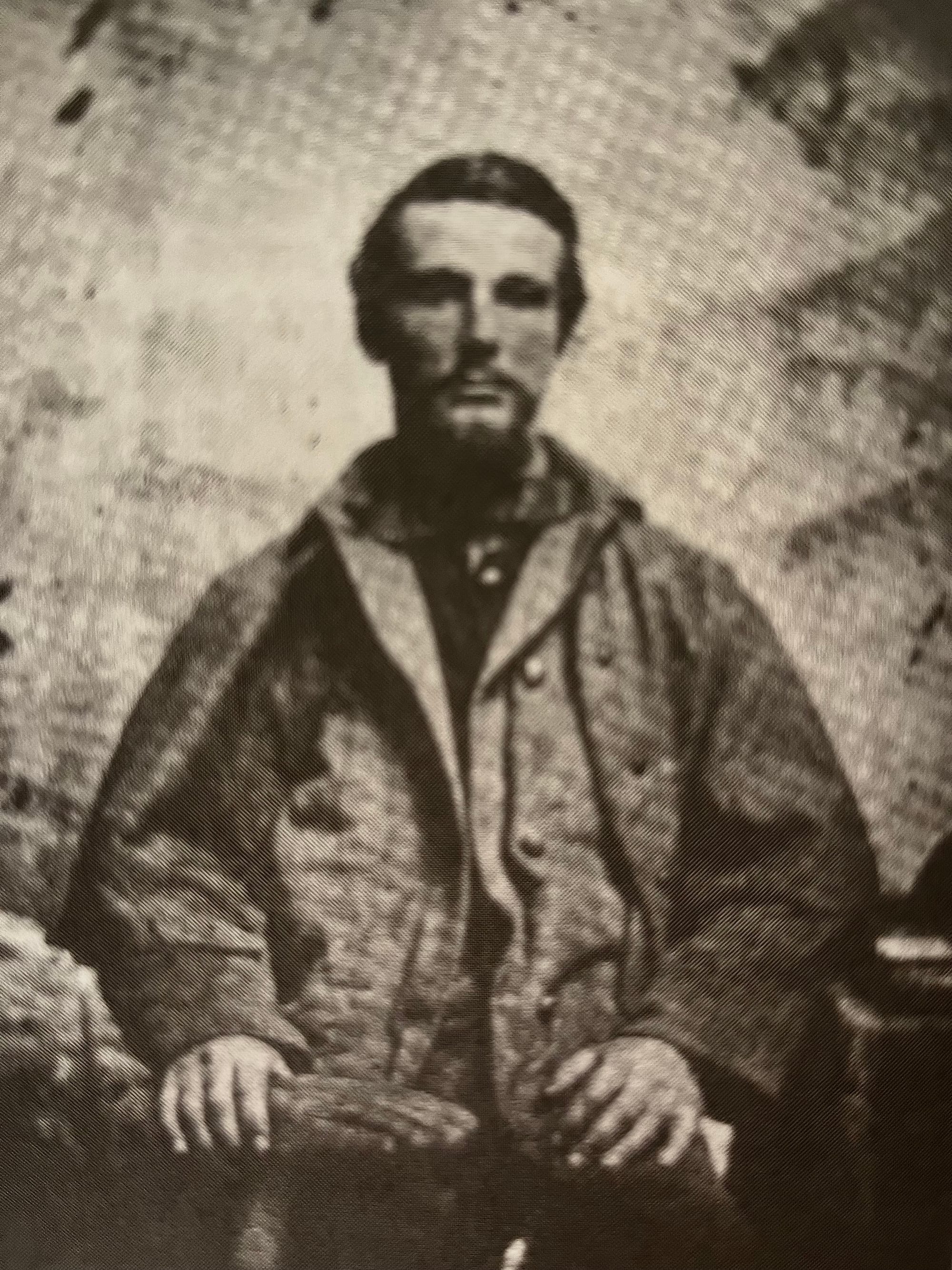
Left, Harriet Jennings Gray, the midwife who married my great-great grandfather from Ireland. Middle, Harriet's mother, Fanny Wilsey Jennings. Right, Private Berea Willsey, Fanny's cousin.
Berea's diary entry partly answers the question of why he and his younger brother, Buel, enlisted. His sardonic tone, though, suggests detachment from the patriotic words he's writing. It's a rare moment when he directly reflects on his purpose. The one he lands on, that of "giving aid," absolutely aligns with what the rest of his diary describes. Over and over, he's there, giving aid.
Most of the time he's aiding his patients, "the boys" in his regiment. Sometimes the soldiers are friends from back home, personalizing the danger he perceives to his country. Incidents early and late in his service intensify this, as Berea aids close relatives.
The first is an intervention he stages on his brother's sore foot, on Buel's 19th birthday, no less. His wry sense of humor surfaces in his account:
"I went down to my quarters & got Dr. Jewett our assistant surgeon, & then started for Buels bunk. I told Buel to haul off his sock fer I was bound he should have his toenail out. So after a good deal of coaxing it was done & Dr. took it out slick and clean. I took it & put it in a paper, saying there was a young lady that wanted that to put with his other one. However he wanted it himself & so I let it go fer a birthday present."
He then nurses Buel through a fever the next month. In early July, Buel is reported wounded. Berea can't get to him. His body is never recovered.
The second incident is from June 9, 1864, his last month of duty. Having seen many battles since losing Buel, Berea is thrust into trench warfare during the Siege of Petersburg. Just two days earlier he's "had the narrowest escape from death I ever had, one shell exploding not a foot from me while eating my dinner."
He must treat another family member, this time a more serious extraction. He writes dispassionately of this surgery:
"The Sharpshooters have been very busy today. We have heard their popping continually. An uncle of mine (John Vining) a sharpshooter from the 37th Mass was mortally wounded this P.M. I dressed his wound & have got the bullet that was extracted from his neck. He was sent to Corps Hospital at 9 oclock PM."
His uncle has been removed from that hospital by the time Berea goes to check on him the next day.
Unlike his commitment to giving aid, Berea's views about the Confederates, and about black people, are less clear. He calls the enemy "Rebs" and "Secesh," but doesn't express animus towards them. A few entries describe random encounters with black people; these reflect racial stereotypes about behavior such as singing and dancing, and features like hair. He refers to them as "darkies" and "negroes," and sometimes uses the other n-word.
A little over a week after his uncle's mortal wound, however, Berea witnesses a division of USCTs (United States Colored Troops). He's arrived at the Petersburg front on June 18th, where he writes,
"I had a splendid view of the skirmishing & of the operations of the enemy . . . Petersburg is almost within a stone's throw of our lines . . . Saw the n— troops make a charge & I must say they are perfect bricks and make splendid soldiers. They take no prisoners."
Berea commends these soldiers in the privacy of his journal. Interpreting that praise requires me to dig deeper. But from a quick scan of other sources, I realize that the conduct of USCT at Petersburg; how white soldiers on both sides regarded them; and how their white commanders treated them, constitute an entire history in itself.
It is clear, though, that the diary entry implies approval for the fact that "they take no prisoners."
Unless we are the current Secretary of Defense, we may use that phrase without considering its literal meaning, along with "give no quarter." However, these expressions don't simply mean soldiers fought so effectively that they killed all their enemies. Both refer to warfare in which even those who actively surrender are killed.
Various personal accounts from Confederates indicate they understood this to be the policy toward their black enemies. Southerners viewed black Union soldiers as insurrectionists to be executed. Their white commanders were considered just as guilty, for having ordered an insurrection.
One of the worst Confederate enactments of "give no quarter" took place in Tennessee on April 12, 1864. Conflicting stories exist about whether the hundreds of Union soldiers—the majority of whom were black—actually surrendered when the Confederates surrounded them at Fort Pillow. But the resulting wholesale slaughter was unequivocal.
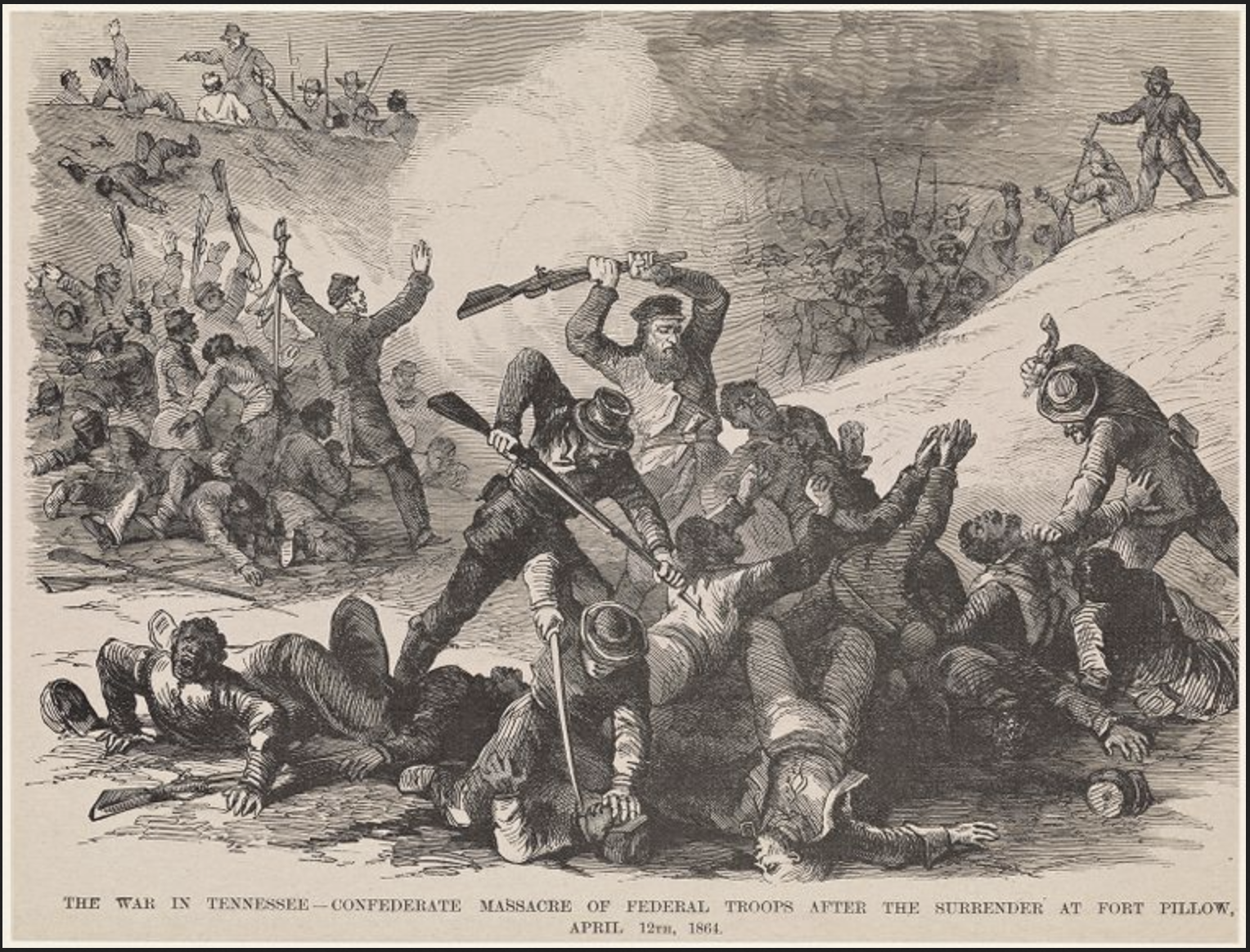
Thus, when on June 15th, black troops attacked the Confederate line at Petersburg shouting "Remember Fort Pillow," they were avenging their slain comrades. It's likely Berea had heard about the USCT's fierce assault on the 15th when he made his admiring note days later. He also knew about the earlier slaughter by Confederates: on April 19th he wrote, "Heard of the Massacre at Fort Pillow (Tenn) in today's paper."
Berea wasn't the only white soldier to praise the USCT. According to Tim Talbot,
"Charles Francis Adams, Jr. then serving in the 1st Massachusetts Cavalry, wrote to his father in June 1864: 'All admit, however, that the [USCTs] fought ferociously . . .'"
Adams adds, sympathetically: "If they murder prisoners, as I hear they did, it is to be lamented and stopped, but they can hardly be blamed.”
 Tim Talbott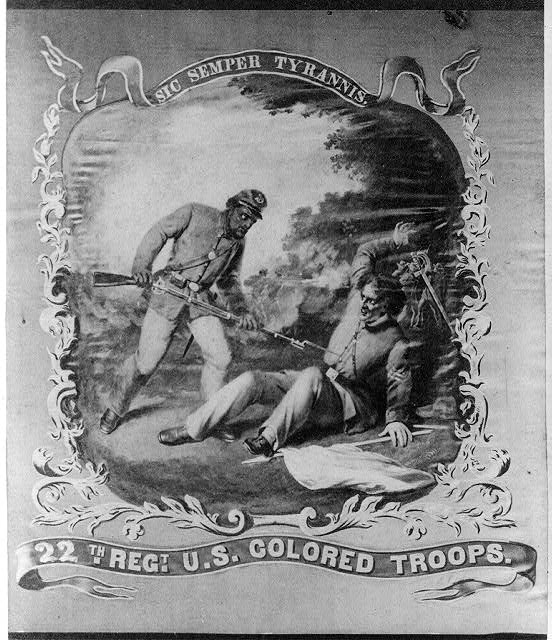
But there were also white officers who didn't like being in command of black soldiers, and there were soldiers in Berea's own cohort who resented the praise for the USCT.
Jennifer Berry points out that "some white Union soldiers in the Army of the Potomac—who had not personally witnessed the fighting on June 15—reflexively discounted the accomplishment of their black comrades."
Some seemed to take it personally, regarding it as a slight against white soldiers:
"Sergeant George Breck, a gunner . . . was willing to give 'due credit to the black soldier for his fighting qualities, but this rendering to Caesar the things that don’t honestly belong to Caesar, and extolling Pompey above the white soldier, for courage and dash, valor, bravery and endurance, may delight some of the devoted worshippers of the ebony idol, but we fail to "see it" ourself.' Breck expressed no objection to 'our darkly-hued "comrades in arms," …rushing into the hottest places of attack…but don’t seek to make him the superior of the American soldier of American or European descent.'”
 Jennifer Berry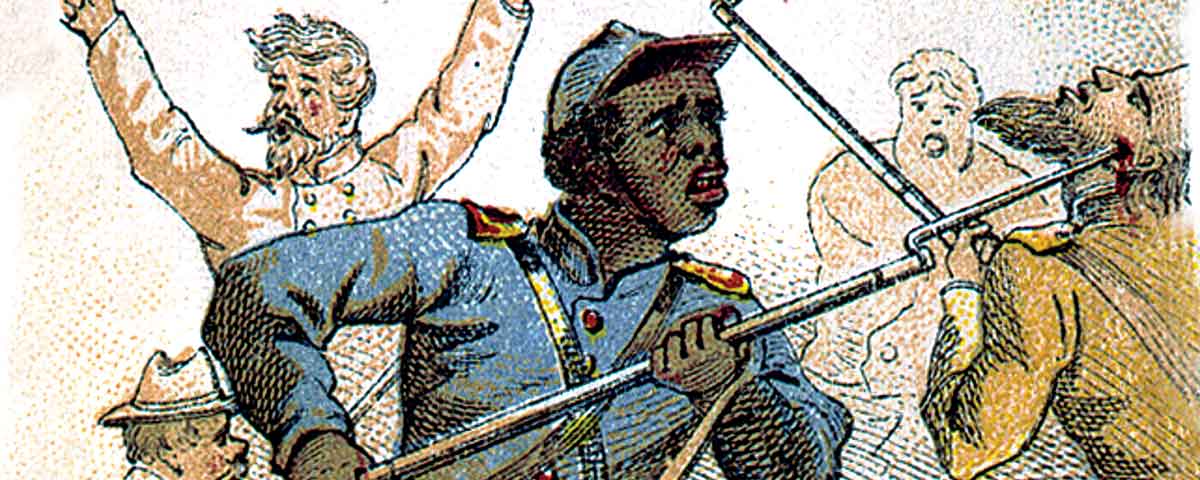
And of course the end of the war did not mean the end of this spectrum of attitudes on the part of whites, Southern or Northern, toward the black population.
When Union General J.W. Geary ran for Pennsylvania governor in 1866 against white supremacist H. Clymer, the latter's campaign promoted racist stereotypes and sought to revive wartime animosities.
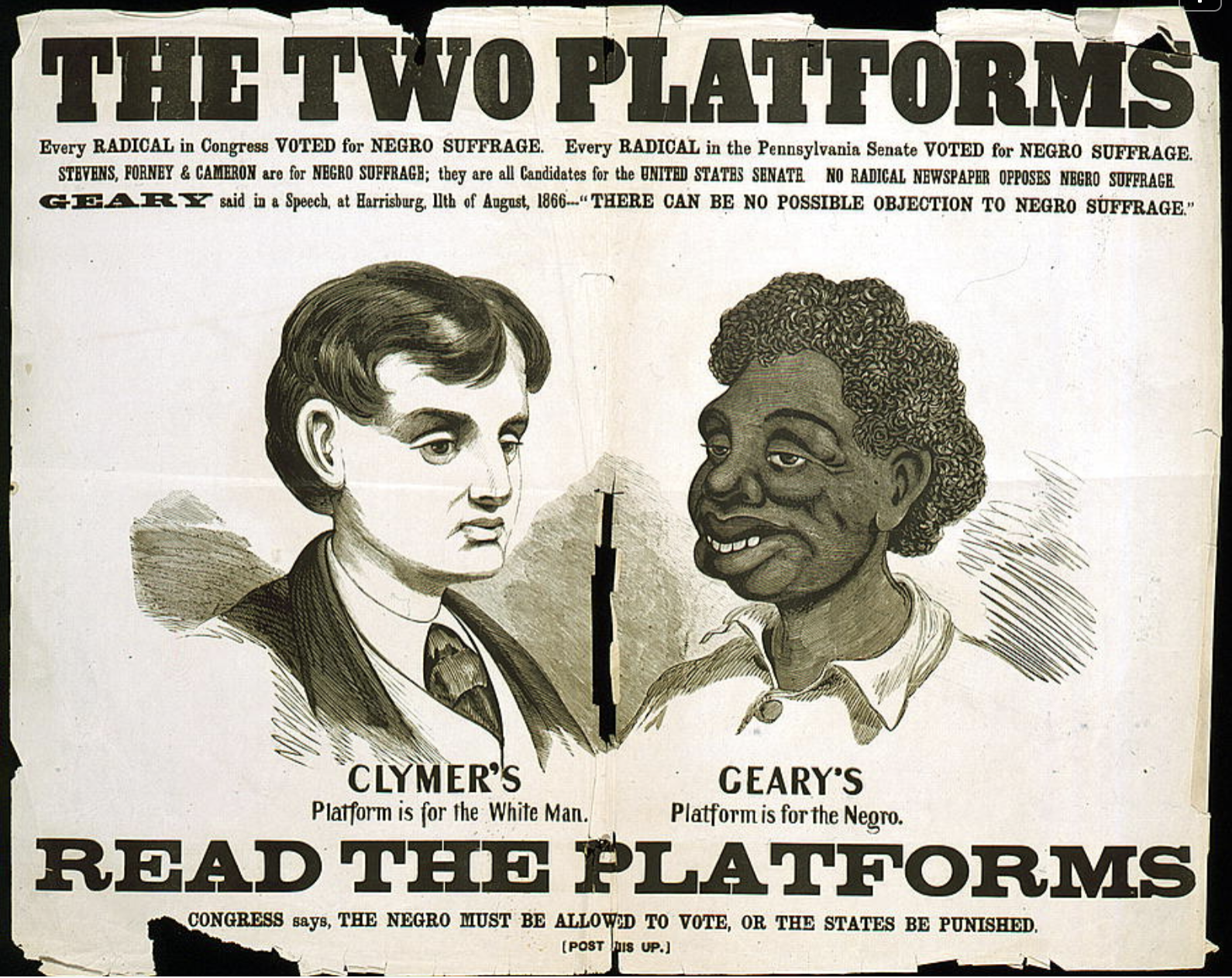
These broadsides carried out a smear campaign, which repeated the word "radical" with the same vehemence we now see used with "communist." It all sounds terribly familiar.
Especially the rage-baiting on display in the following example.
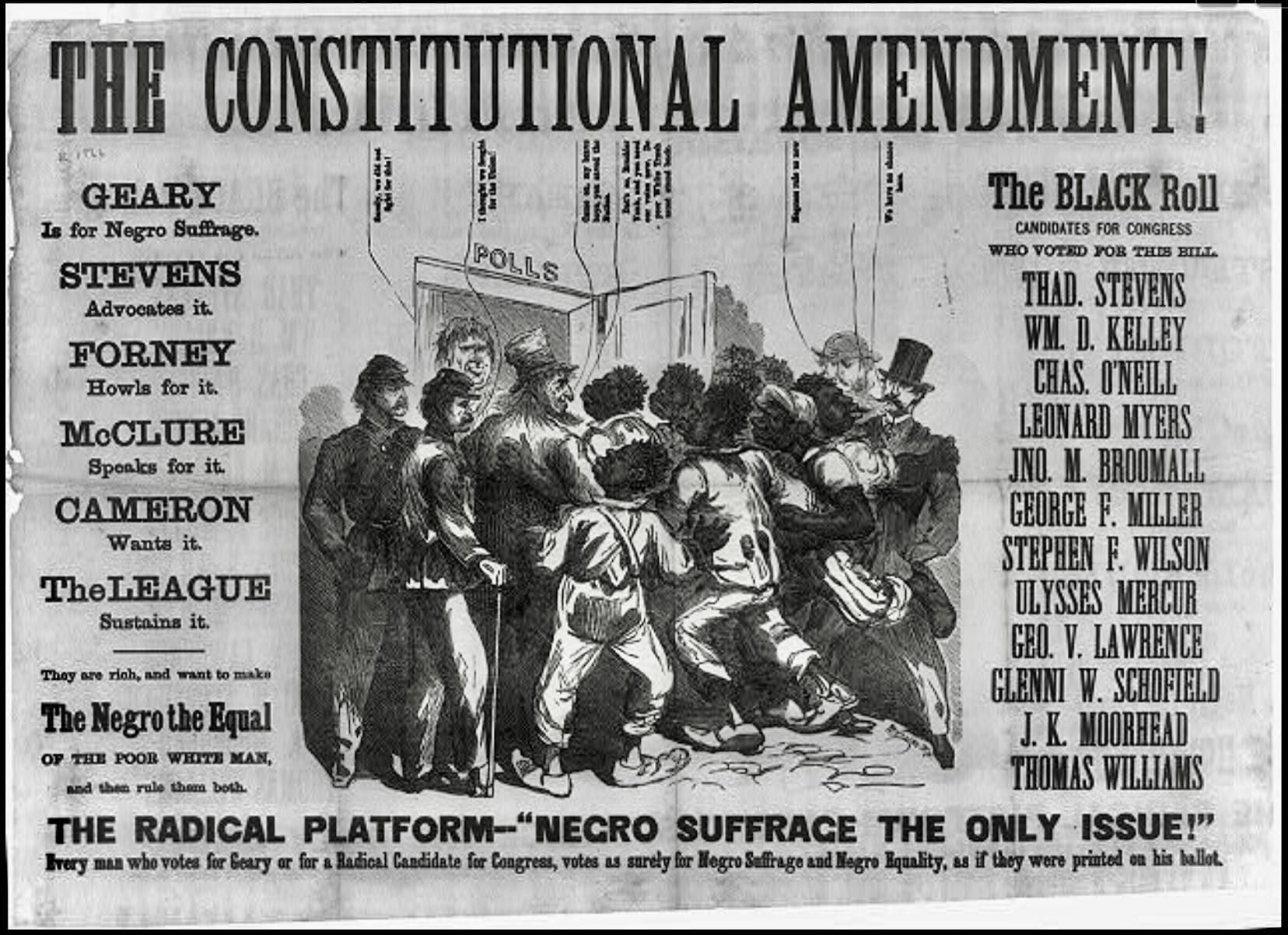
The Library of Congress quotes the broadside's small speech text in this description:
"a group of black men are shown crowding ahead of two white veterans and other whites toward a door marked 'Polls.' One veterans complains, 'Surely, we did not fight for this.' Another remarks, 'I thought we fought for the Union.' A straggly bearded man encourages the blacks, 'Come on, my brave boys, you saved the Nation.' The black response is, 'Dat's so Brudder Yank, and you need our votes now. De poor White Trash must stand back.' At right two more white men complain, 'Negroes rule us now,' and 'We have no chance here.'
Culminating in the shouted question of "White Men & Women ARE YOU READY FOR THIS?" the next broadside offers the typical caricatures slurring blacks, while painting the entire party as dangerous radicals.
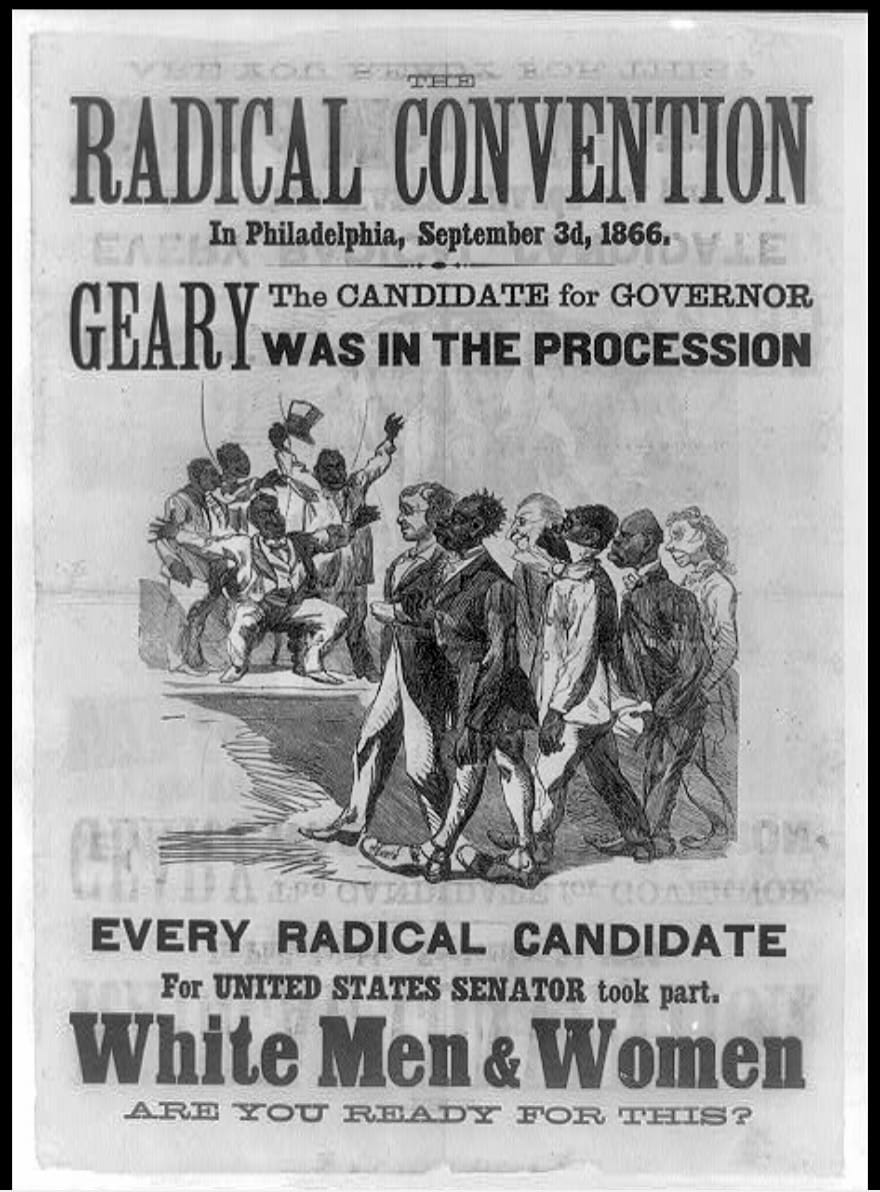
Fortunately in that election, Geary won.
The spectrum of attitudes remains. Propaganda scripts resembling these broadsides have long lived on in the shadows, gaining strength. They are increasingly emerging into the light. Political descendants of H. Clymer are now in charge.
How are we to each give our aid in bringing peace to the land?