Taking Action

"Whatever you do may seem insignificant, but it is most important that you do it" attributed to Gandhi
This was not the essay I'd planned to write today. But it demanded that I sit down and work it out. It's runs long, because I needed to bring in the powerful words of other people.
I hope you find something in this letter that you, too, will act on or will feel compelled to share with others.
As I've previously written, my Learn, Imagine, Act project is designed to start mending the gaping holes in my and no doubt others'—especially white people's—education. But it isn't solely about learning what's been left out or misrepresented.
The Imagine part is about practicing empathy, and also about imagining constructive responses to our collective problems, coming up with new, sustainable ways of organizing and governing ourselves, and then working to act on these ideas.
I'm leaning into Act territory this week, where we harvest the fruits of our learning and imagining, and bring it to serve our world, in whatever way we can. I'm grateful for all those who have been in Act territory for years, as well as those for whom getting involved outside their personal circles is a new experience. We need everyone.
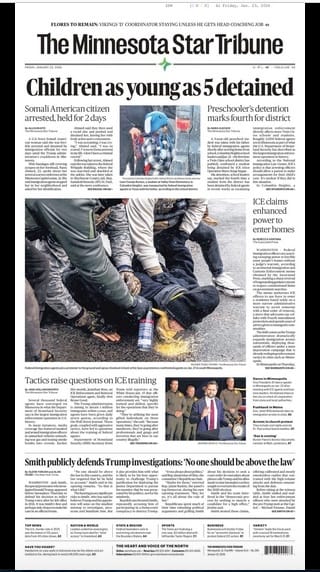
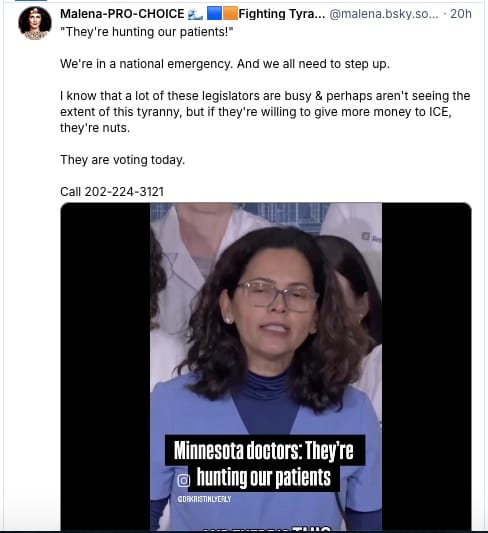
Maybe you're wondering what to do today, this weekend, and beyond. Especially after you've seen horrific headlines and sickening photos such as those in today's Minneapolis Star Tribune, or heard testimonies like the one from the Minnesota doctor here, saying, "They're hunting our patients."
When we can reach past the overwhelm to which we're being intentionally subjected, we actually have a lot of options to act. I'll share some here, along with information meant to motivate us to step up.
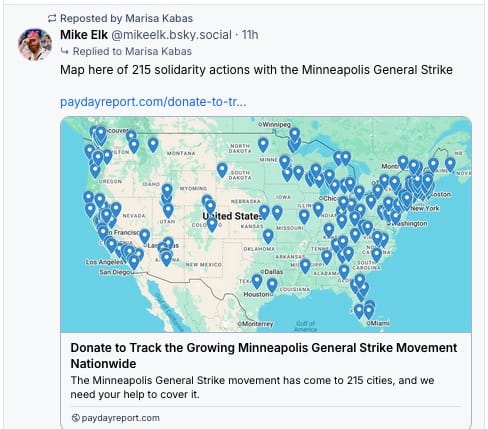
First, there's the Minneapolis General Strike today. Here's a visual of all the places where solidarity actions are taking place.
This next site is collecting and vetting relief actions that you can support:


This site's information literally allows you to follow Fred Rogers' advice to "find the helpers," and help them.
This screenshot gives you an idea of the range of support you could offer:

Maybe you can't get out to demonstrate. You may not be able to go on strike. It might not be possible for you to avoid making purchases today. You might not have money to donate.
But a message to your Congressional representatives is a worthwhile action. Sharing information with your social circle in order to motivate others—who may have the time, money, or capacity to do more right now—is a worthwhile action.
Because the situation is urgent.
"Concentration camps involve the mass detention of civilians without due process on the basis of political, racial, ethnic, or religious identity. And that is where we’re at right now" Andrea Pitzer
 Andrea Pitzer’s Degenerate Art
If you've never opened any of the links I include in my letters before, I hope you'll look at this one. I consider Andrea Pitzer's information to be of utmost importance to understanding what is at stake right now.
She's the author of One Long Night: A Global History of Concentration Camps. Her article contextualizes our current situation, to clarify what we're up against:
"The situation we’re careening toward right now is building on prior and existing abusive systems of detention, immigration, and policing in the U.S. We are effectively lifting up the Klan and slave patrols and putting them not adjacent to law enforcement officials but in charge of the systems themselves. (emphasis mine)
Congress has already allocated funding that will create a camp system that could, on its own, surpass our existing (massive) prison system. The state is already trying to use modern surveillance methods to control communities both outside and inside the camps."
Her statement here leads to my next concern:
Slave patrols combined a quasi-official role with citizen vigilantism. At the far end of the spectrum, the U.S. government has had an overt and vicious history of harming civilians from its founding, with Native genocide and chattel slavery.
People of color are speaking out right now. Consider the case of Nekima Levy Armstrong: https://www.theguardian.com/us-news/2026/jan/22/white-house-ice-protest-arrest-altered-image. A civil rights attorney, she was arrested by dozens of agents in a display of force for protesting in a church, despite offering to turn herself in.
For Native peoples across the country, but most especially in Minneapolis neighborhoods, the throughlines of brutality are all too clear.
I fear that many well-meaning white people have no clue about it. And our ignorance helps make its continuance possible.
For a brief but hard-hitting illustration of this concentration camp throughline, please check out Sean Sherman's FB post linked here (or on Instagram @the_sioux_chef). https://www.facebook.com/reel/1770971630529616
A Minneapolis chef, Sherman is author of The Sioux Chef's Indigenous Kitchen and Turtle Island: Foods and Traditions of the Indigenous Peoples of North America and cofounder of:


Sherman gives us a concise account—directly related to his own family history—of Fort Snelling and the Whipple Detention center.
As Schafer's article details below, "Fort Snelling was a concentration camp used by the United States during the Dakota Indian Wars to imprison thousands of Dakota and Ho-Chunk people in abysmal conditions." ICE has recently detained Native residents to this very site, where "famine, disease and malnutrition killed approximately 300 Dakota prisoners, a majority of which were women and children."
 Amelia Schafer
Huntington's article describes another throughline—Indigenous Patrollers bringing aid:
"'A cohort of Indigenous patrollers has now reached close to 100, Bellecourt said. 'We’re running from seven in the morning to seven in the evening,' he said. . . . We still have some patrollers going out until like 11 or 12 at night.'
. . . the patrollers are on the street to help community members feel safe. 'It’s really scary here,' said Mary LaGarde, executive director of the Minneapolis American Indian Center . . ."
 Stewart Huntington
Judith LeBlanc notes that 35,000 Native people live in Minneapolis-St. Paul. She addresses the question of action, reminding us that we can call attention to the problems, and the solutions we demand:
"During times like these, we often ask ourselves: what can I do? Luckily, there are deeply passionate organizers across the country who know how to exercise our right to free speech and assembly. So much of the political and social changes we have seen throughout U.S. history started with everyday people organizing together. Communities mobilized around issues and causes, compelling politicians and governments to take notice."
 ICT Opinion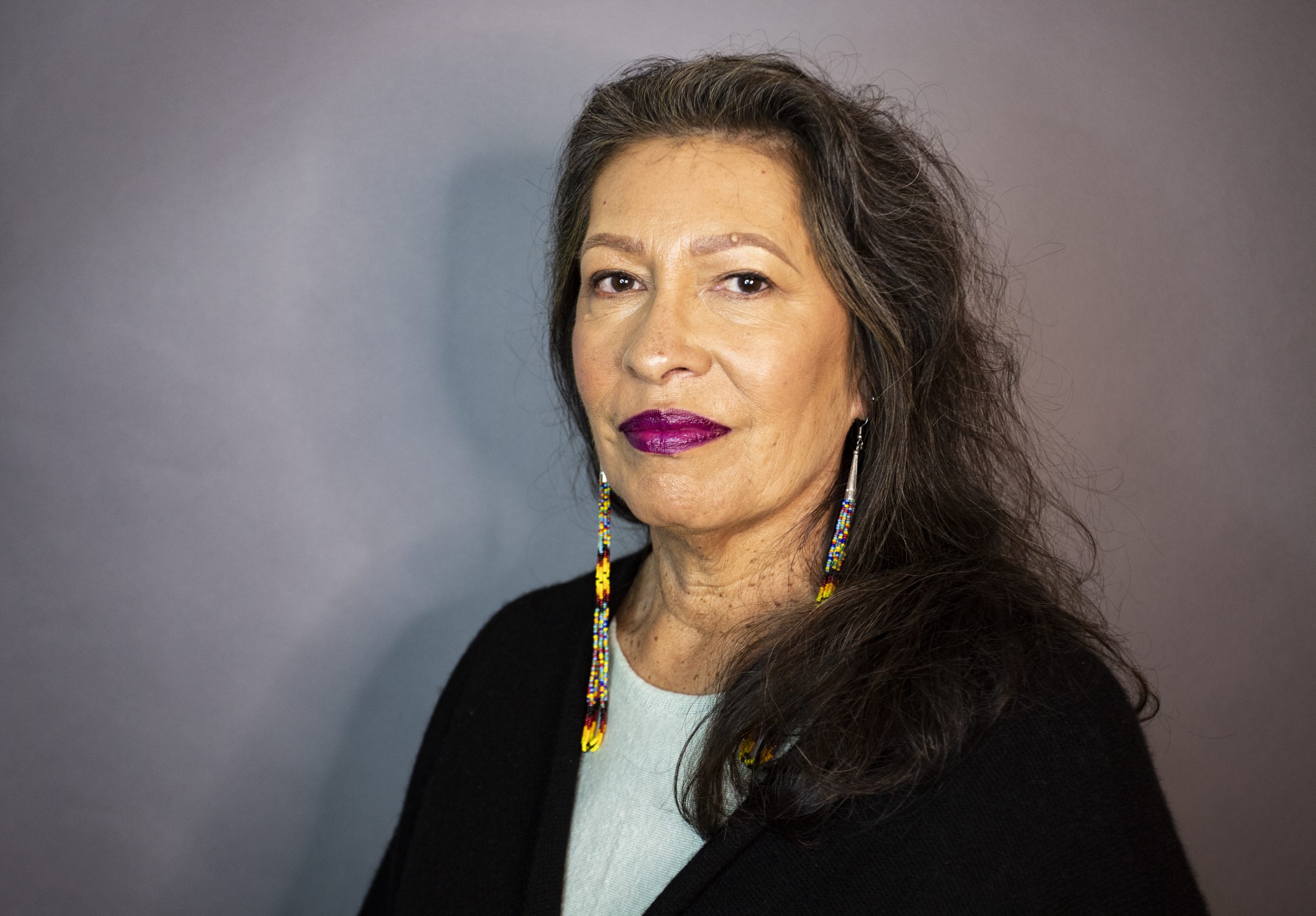
As LeBlanc points out, "The demonization of Renee Good is an all too familiar story for those who have spoken out for communities. For centuries, Native peoples have been depicted as warmongers, savages and radicals when we organize or protest for our lands and rights. We have seen these narratives play out first hand in more modern times . . ."
"When thousands of Native peoples and conservationists from across the U.S. and world stood together with the Standing Rock Sioux Tribe to say no to an oil pipeline . . . we were met with rubber bullets, water cannons, attack dogs, and tanks. We didn’t back down then, and we won’t now. " Judith LeBlanc
So please take courage from all the people who are doing what they can, often at risk to their safety and that of their family.
We can do more than we might even imagine, on our own: one woman put together the Stand With Minnesota Directory I shared above.
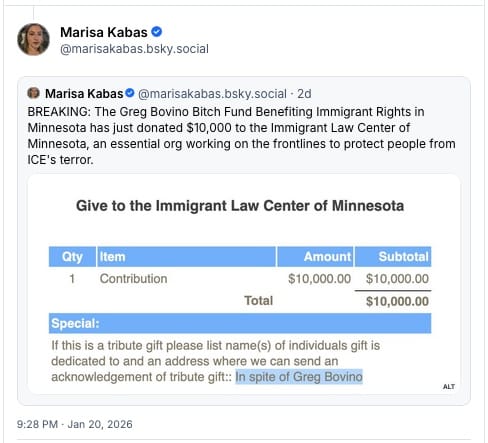
Independent journalist Marisa Kabas set off a storm of donations this week over the course of a single day, simply by calling CBP leader Greg Bovino a bitch on Bluesky. Mostly through small donations, individuals helped her raise $18,000 for immigrant rights organizations in Minnesota:
 Marisa Kabas
Yes, there's SO much to be done, but it all counts.
Especially because the atrocities will continue to spread if we don't. While immigrants are being hunted everywhere in this country, Portland, Maine has become the next public target.
Minister Jodi Cohen Hayashida posted these details on her Facebook account:
"Today in Maine, just like yesterday and just like the day before, ICE detained anyone too brown for their liking. They pulled people over, smashed their windows, dragged them out of their cars and left the cars empty and running on the side of the road. They staked out bus stops. They staked out businesses. They staked out apartment complexes.
Today, those abducted by ICE included an engineer, living and working here legally. A business owner and father, living and working here legally. A Cumberland County Sheriff's department recruit, living and working here legally. In the comment section of the news conference at which the Sheriff explained in painstaking detail the legal vetting a recruit undergoes, proving beyond measure that the recruit was here legally, people wondered, "How did an illegal get hired by the Sheriff's department?"
Today I heard from a hospital chaplain colleague that the hospital at which they work had close to 50% of its staff call out in some departments because people are too terrified to go to work. Neighbors are transporting children to school because parents are afraid to leave the house. People are running out of food because they can't safely go shop. These are people that we love. These are people that love each other. These are people who love, or at least loved, Maine.
Today, like yesterday and the day before, MaineX agitated its followers towards violence by spewing lies about our immigrant neighbors that are too absurd to be believed but are believed anyway because there have always been people in this country who enjoy seeing others hurting and will grab hold of whatever excuse allows them to continue to do so without shame.
There are no words to describe the rage I feel.
It would have burned me to ash by now if I hadn't also seen today, like yesterday and the day before, the kind of incandescent love and fierce solidarity that I would describe as holy, or feel the weaving of beloved community not fraying but rather pulling tighter under this onslaught.
The kind of repressive, race-based, state-sanctioned violence our community is experiencing right now is in the blood and bones of this country. But so is the irrepressible love that is flaring up in response, calling us towards one another and the promise of the world we can still choose to create for all of us. May we always choose that love."