Avoiding Technologic Overreach: Humans, the Biosphere, and AI

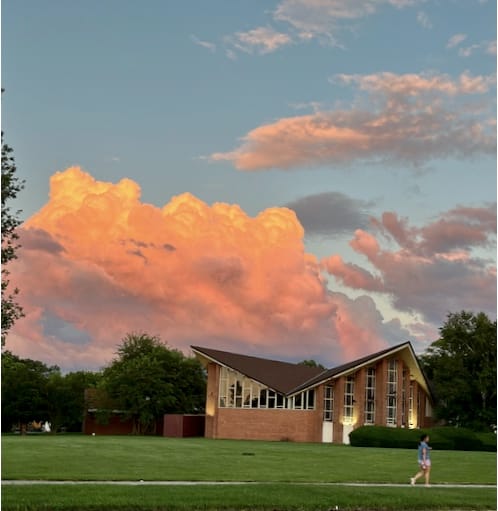
I need to go outside. To remind myself of the sky. To admire clouds and trees, their shapes and surfaces, and to think about how they come to be. I need to walk. To feel my muscles moving in relation to earth and air, and to sense the rhythms of my thoughts and steps as they begin to entrain to each other. If I go a few days without this sensory richness, I do not feel well—well in the sense of whole.
Perhaps this is why a quote from John A. Livingston has stayed with me for the roughly twenty years since I encountered it. Livingston was a naturalist, whose books spanned from the sixties through the early nineties. His comment was presented by environmental activist Derrick Jensen, as a remembered conversation:
“Nowadays most of us live in cities. That means most of us live in an insulated cell, completely cut off from any kind of sensory information or sensory experience that is not of our own manufacture. Everything we see, hear, taste, smell, touch, is a human artifact. All the sensory information we receive is fabricated, and most of it is mediated by machines.
“I think the only thing that makes it bearable is the fact that our sensory capacities are so terribly diminished—just as they are in all domesticates—that we no longer know what we’re missing. The wild animal is receiving information for all of the senses, from an uncountable number of sources, every moment of its life. We get it from one only—ourselves. It’s like doing solitary in an echo chamber. People doing solitary do strange things. And the common experience of victims of sensory deprivation is hallucination. I believe that our received cultural wisdom, our anthropocentric beliefs and ideologies, can easily be seen as institutionalized hallucinations.” https://derrickjensen.org/endgame/solitary-in-an-echo-chamber/
This characterization still hits me hard. There's an audible, almost palpable ring of truth in it, even while it seems exaggerated, more like a hyperbole than a literal description. Maybe we are becoming more insulated, sense-diminished, and more and more solitary. But we are not completely cut off from all but human-fabricated sensory input. Yet.
I agree, however, that humans are spending more time in predominantly human-mediated environments, interacting with human artifacts at great and so-far untallied expense. In the two decades since reading Livingston's words, I've watched it happen. I've been primed, if not convinced, by his shocking perspective. I often look around and wonder, what am I seeing that wouldn't be here right now if a human hadn't had something to do with it? What are people around me doing that doesn't require a human artifact to mediate their experience?
Let me clarify here that I love a great deal of what humans have made. My answers to these questions are not automatic negative judgments. The problem comes from different degrees and kinds of displacement at work: from the types of damage, opportunity cost, or usurpations being inflicted by the human-made presence in the environment.
Today, though, our fabricated experience isn't solely about living in cities, but about living in and through screens, in the ever-expanding technosphere. Interactions with objects and lifeforms outside of it are becoming vanishingly rare for large portions of the population. I have no doubt that it is affecting mental health.
Many people, indeed, do not know what they're missing, and if someone told them, they might argue they had acquired lots of other great new things instead, so no problem. But how would they know?
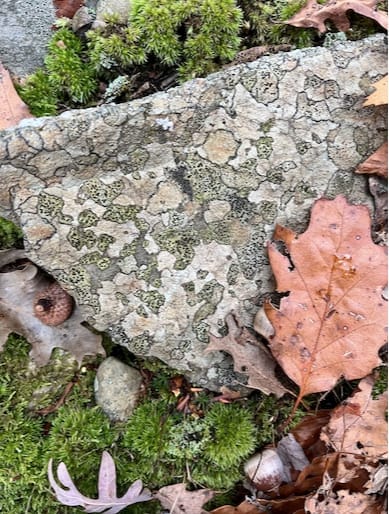
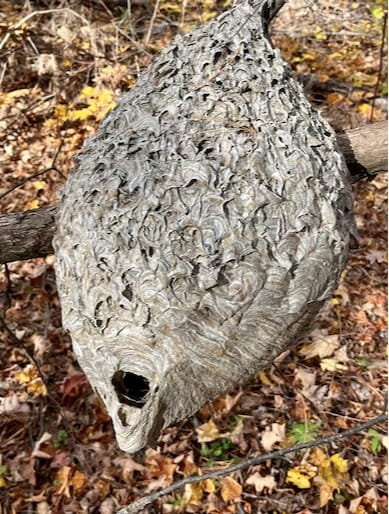
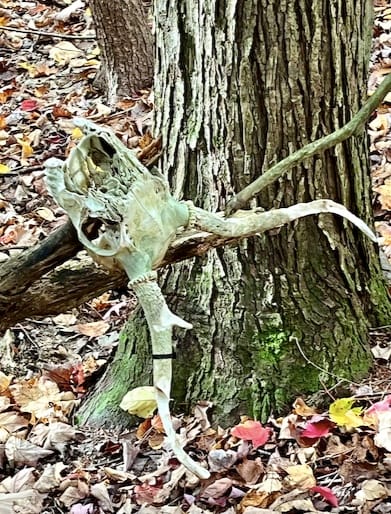
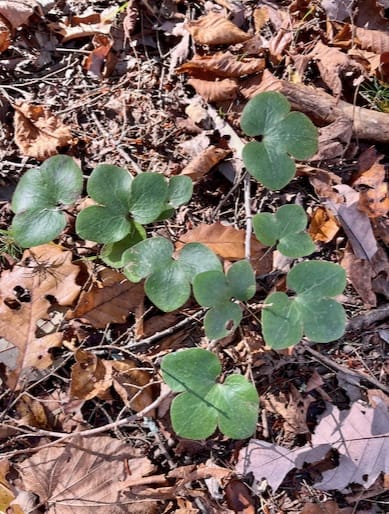
Rock, Paper wasp, Skull, Hepatica: Faces of the fall forest, Hudson Valley
Quite a few friends on social media express surprise and wonderment at what I routinely share from my walks in local woods. They really don't know what's out there. It took me years, during adulthood, to manage to look for it myself. But I had at least had a somewhat outdoor upbringing and a history of interest in nature, before getting sucked into the machine.
Around the time I encountered Livingston in the early 2000s, I also heard Andrew Kimbrell talk about "Cold Evil" at the Schumacher Institute. Speaking of what our technology (especially militarily) makes it possible to do at increasing levels of personal remove or even understanding, Kimbrell notes:
"Clearly, living in the technosphere raises very different ethical questions and responsibilities than did the past milieus of human existence. We find ourselves not only in a novel physical environment, the technological system, but also in a new ethical landscape.
In The Enigma of Evil theologian Alfred Schutze sums up this evolution of ethics in our technological times: . . . It shows up impersonally in arrangements and conditions of social, industrial, technical and general life which, admittedly, are created and tolerated by man. It appears anonymously as injustice, or hardship in an interpersonal realm where nobody seems directly liable or responsible. . . . It has become the grey eminence infiltrating all areas of human existence . . . ." https://centerforneweconomics.org/publications/cold-evil-technology-and-modern-ethics/
This grey eminence sounds a lot like the infiltration of AI into our lives.
Moving Forward While Looking Backward: Astute Questions vs Cherry-picked Data
Last week, I shared several different lists of questions to ask about any technology. Since then, I've been reading Shannon Vallor's book, The AI Mirror: How to Reclaim Our Humanity in an Age of Machine Thinking. Vallor is a philosopher at the University of Edinburgh, with a position as Professor in the Ethics of Data and Artificial Intelligence. She has worked at Google as an AI ethicist, and is member of the One Hundred Year Study of Artificial Intelligence. Vallor explores the metaphor of the mirror to delve into the many implications of our uses of this technology. There is a lot to unpack in her metaphor, but very simply put, it describes a technology that reflects back to us merely an "output" resulting from biased input, which then acts to limit the image we receive of who we are and what we are capable of.
I'm not yet ready to respond in detail to Vallor's multi-faceted argument. But I do want to highlight some strands. These relate to throughlines in my own history of reading about technology and the environment. One of my earliest influences in this area was Oberlin ecological design professor, David Orr. His 2002 book, The Nature of Design: Ecology, Culture, and Human Intention, introduced me to a more condensed list of questions than the 80 I shared last week. As such, they have acted as a simple set of personal tools, helping me make decisions about about what I'm consuming, making, or acting upon:
"Designing ecologically requires a revolution in our thinking that changes the kinds of questions we ask from how can we do the same old things more efficiently to deeper questions such as:
1) Do we need it?
2) Is it ethical?
3) What impact does it have on the community?
4) Is it safe to make and use?
5) Is it fair?
6) Can it be repaired or reused?
7) What is the full cost over its expected lifetime?
8) Is there a better way to do it? (28)
Each one of these questions can open up a host of others. Many of them help illustrate the concept that we shape our tools and they shape us.
The history that brought us here and that we carry within us, is also a type of reciprocally-shaping force. This is where Orr and Vallor strike me as offering some parallel ideas. Orr opines that "We are prone to overdo what worked in the past, with the result that many of our current problems stem from past success carried to an extreme" (25).
Vallor's argument about AI's data-based mirroring function takes this a step further:
"What AI mirrors do is to extract, amplify, and push forward the dominant powers and most frequently recorded patterns of our documented, datafied past."
Significantly, these patterns aren't actually representative of humanity in general, or of human efforts that "worked" in the past. This fact is a problem, but also suggests a possible path to solutions.
She continues, "Instead of asking one another what we might now become, we ask AI mirrors to show us who we already are and have been, and to predict from there what must come next . . . this loss of freedom to envision more human yet unmade possibilities has roots that long predate digital computers" (10-11).
Vallor notes that "rescuing ourselves from the threat posed by AI need not mean eliminating AI," as that constitutes "a wide and diverse range of technologies, many of which are immensely beneficial and even essential tools for the highest moral task we face today: reconstructing the built world for sustainable human and planetary flourishing" (9).
In other words, some of this technology can be used to help us with the task of ecological design that Orr was heralding. We need a lot of tools for this task, as it has only become more pressing since he wrote his book.
Orr was concerned with certain gaps in and limits to our knowledge, that "after a century of promiscuous chemistry . . . who can say how the 100,000 chemicals in common use mix in the ecosphere or how they might be implicated in declining sperm counts, rising cancer rates, disappearing amphibians, or behavioral disorders? And having disrupted global biogeochemical cycles, no one can say with assurance what the larger climatic and ecological effects will be. Undaunted by our ignorance, we rush ahead to reengineer the fabric of life on earth. Maybe scientists will figure it all out. It is more probable, however, that we are encountering the outer limits of social-ecological complexity, in which cause and effect are widely separated in space and time, and in a growing number of cases no one can say with certainty what causes what" (26).
Many proponents of AI today would claim that their technology, allowed to take its present course, will enable us to go beyond such "outer limits," by using these machines to calculate effects. Vallor offers some strong arguments about the problems underlying such an assumption, but I'll save those for a future post.
For now, I just want to suggest the basic premises Orr and Vallor are each attempting to clarify in their approaches. Orr wants us to see that
"the environment outside us is also inside us" and that "the standard for ecological design is neither efficiency nor productivity but health, beginning with that of the soil and extending upward through plants, animals, and people. It is impossible to impair health at any level without affecting it at other levels" (29).
For Vallor, a key understanding is that we can't easily "fix" the various problems with AI and expect to use it healthfully if we don't recognize and reform the human values it is already working from:
"AI isn't developing in harmful ways today because it's misaligned with our current values. It's already expressing those values all too well. AI tools reflect the values of the wealthy postindustrial societies that build them. These are the very values that brought us to our current heights of scientific ingenuity, but also to the sixth mass extinction and the brink of planetary devastation." (10)
In this, I hear echoes of Orr's belief that, "at the heart of the issue of design, then, are procedural questions that have to do with politics, representation, and fairness" (28).
I'll end with a personal reflection involving design, tools, mirrors, history, and the relationships we are in with our environments. Maybe you'll have some thoughts about your own. I'd love to hear from you about it.
I'm writing this in a small room with one window. After the leaves fall from neighborhood trees, and depending on weather and light, I can just barely see a bit of the blue, curving forms of the Catskills from this window. They are nearly sixty miles away. I lived in this house more than 15 years before I discovered this miracle. Now, especially around the golden hour, I make a practice of checking on those mountains. Positioning myself at the window's edge, I shift up and down on my toes, to catch a glimpse through the tree branches. It's both a reality check and a moment of awe.
Since spring of 2020, this room also contains two large acoustical panels on facing walls and a full-length mirror inside the door. My son made these adaptations to help continue with his development as a violinist, when he was trapped in this childhood bedroom while Covid shut down his university. These are tools that impart to the room a certain character, one that even I as a non-musician, non-technical person, can recognize and appreciate. I'm not going to alter that now.
I am in awe of the science of acoustics—how sound can be engineered, be directed through spaces at different speeds and intensities, even be shaped by its environment to have various qualities. This is true from the macro of the large music hall, to the micro of the acoustics of an instrument itself. In the case of a violin, for example, the tuning of the strings, the condition of the bridge, the wood itself, all these elements have a role in how the sound is produced and how we will hear it. This isn't even factoring in environmental aspects such as temperature and humidity. Or the mood of the musician, or the emotional life of the composer. Or whether a pandemic has traumatized or disabled members of the orchestra, or the orchestra's funding has been cut.
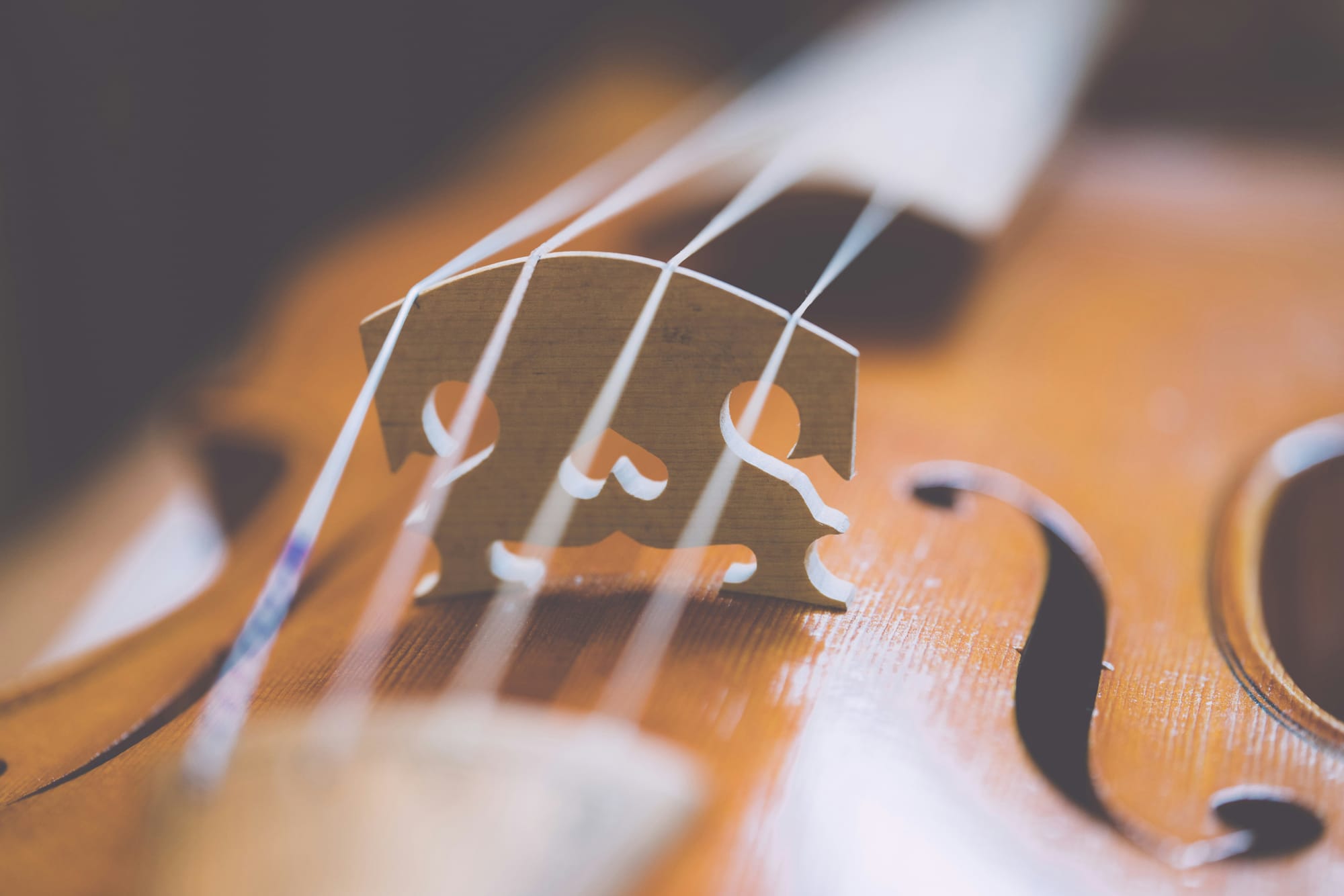
In its own way, this whole complex dynamic feels like Orr's statement that the environment outside us is also inside us. Maybe let that resonate for a moment: the environment outside us is also inside us. This might be in bad ways—think microplastics and other pollutants—or good ways, such as mountains and music.
After my son moved out again, I began using the room. Cork bulletin boards and other methods for displaying artwork and quotations have gone up alongside the acoustic panels. I've made these adaptations to further my own development as a writer and illustrator. I've been surprised by how much something so simple has helped my work.
I love creating within the supportive space of all these adaptations and that window with its late-discovered view. Like going outside, spending time here contributes to my well-being. Have you experienced built environments that support your health and flourishing? What have these been for you?
As always, if you've read this far, thank you for being here. I will be taking the next two weeks off to catch up a bit on reading, and to take a break so I don't break.
 Ruth Ann Smalley
I'd love to hear from you, and hope you can rest and refill your cup, as well.